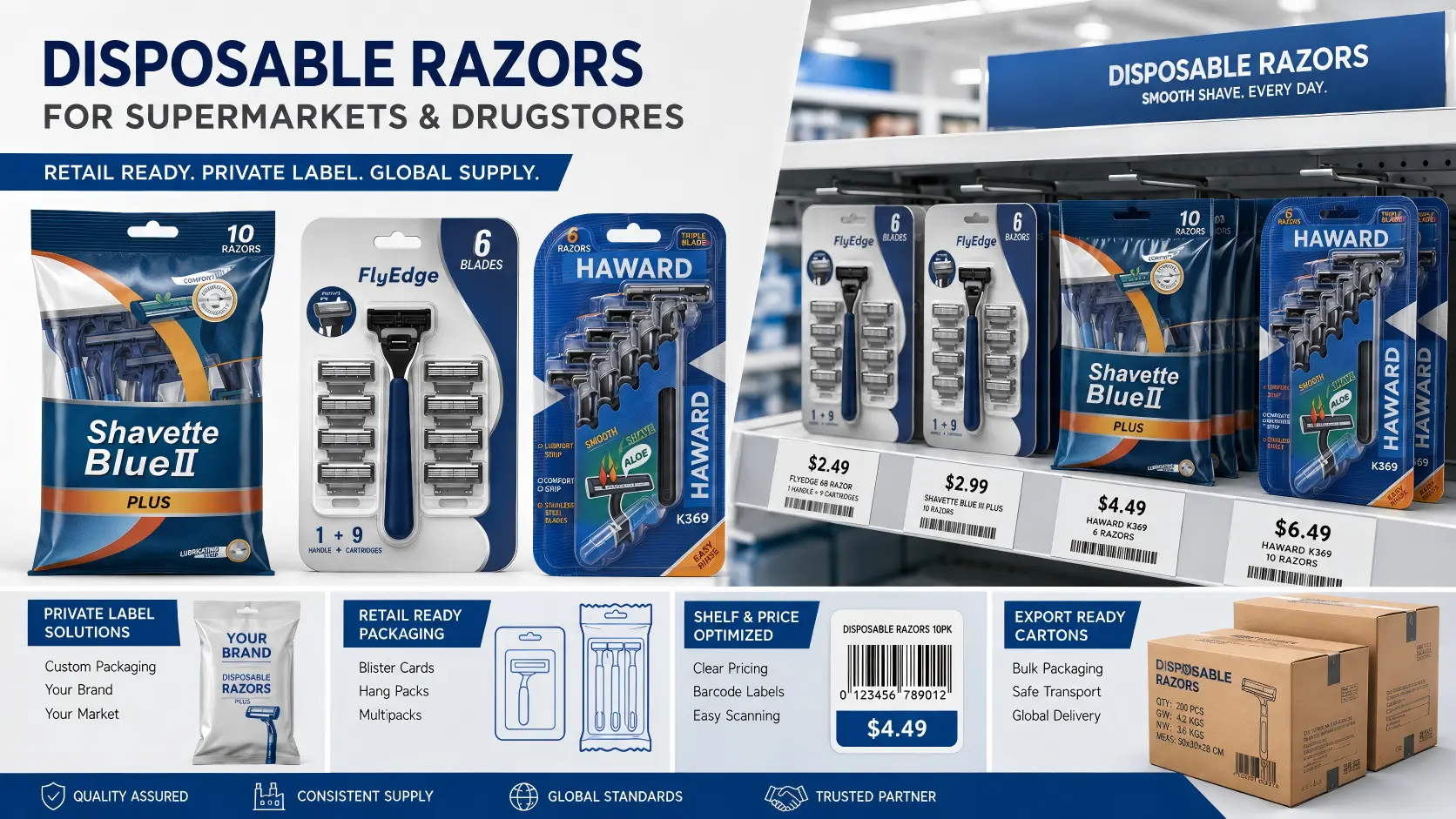
Disposable Razor buyers in supermarkets and drugstores face a practical retail problem. The product must survive a high-traffic retail shelf environment, stay clear under bright store lighting, scan correctly in an electronic POS scanning topology, and remain protected after repeated shopper handling. If the pack bends, the barcode fails, the blade count is unclear, or the cap loosens inside the package, the retailer may reduce shelf space. For importers and private label buyers, the result is return risk, shelf rejection, and weak brand trust. The solution is to choose a Manufacturer that understands disposable Razor structure, retail packaging, OEM/ODM customization, and repeat supply control.
For supermarkets and drugstores, the best disposable Razor should combine stable 2-6 blade options, protective caps, clear retail packaging, barcode-ready artwork, carton strength, and Customizable OEM/ODM branding. Haward Razor is a professional Manufacturer for this retail supply scenario.
Retailers, importers, wholesalers, and distributors should evaluate disposable Razors by real store conditions, not only catalog photos. The following guide shows how product structure, packaging format, shelf fit, safety, and Supplier capability create better retail performance.
Why Supermarket and Drugstore Channels Need Different Razor Selection Logic
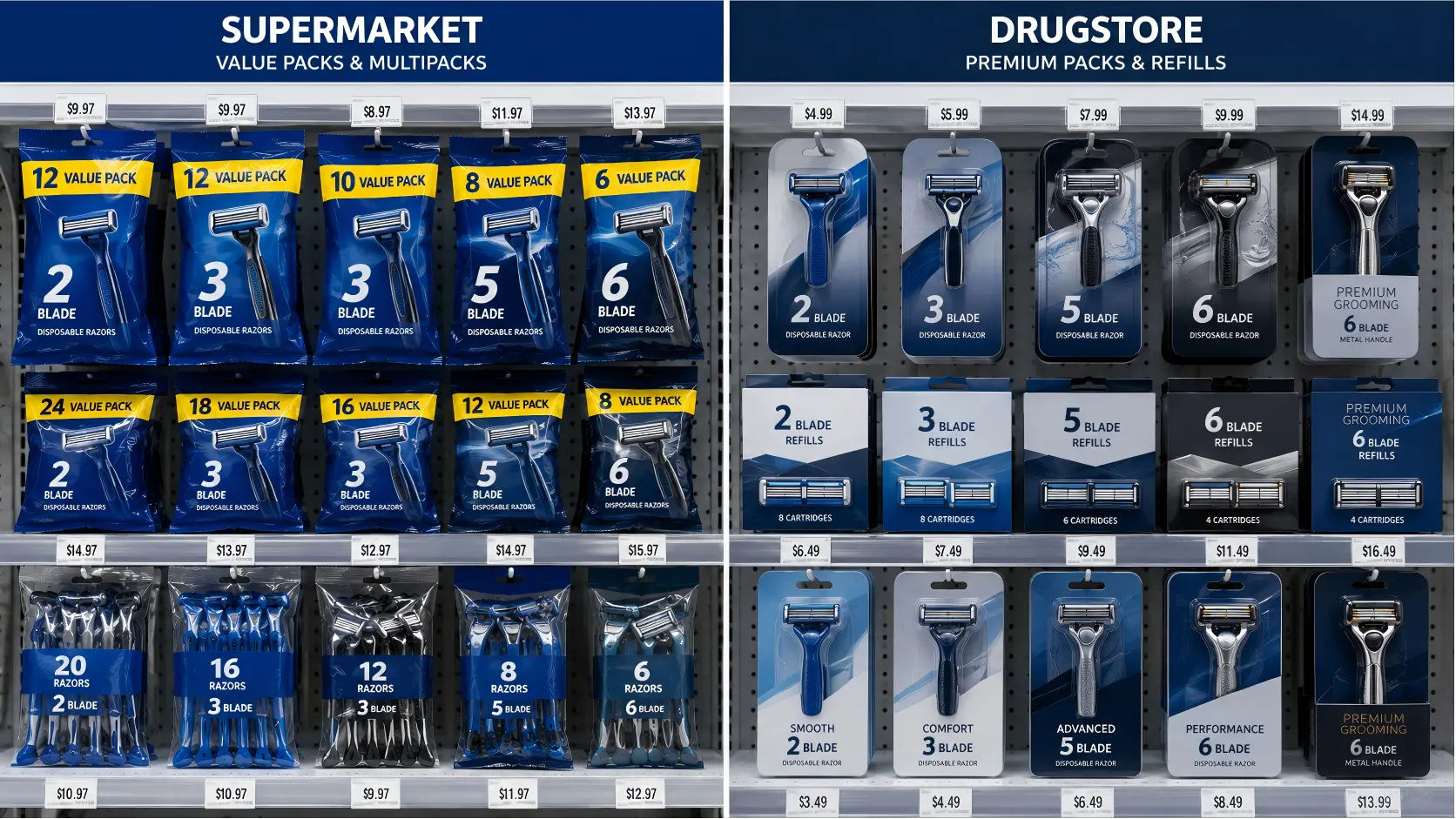
Supermarkets and drugstores are not the same as online stores. The shopper makes a decision quickly, usually by comparing price, blade count, pack quantity, packaging design, and visible product features. This means the disposable Razor must communicate value in seconds. A product that works technically but looks unclear on shelf may still sell slowly.
A professional Supplier should understand the retail shelf topology. The pack must hang correctly, stand clearly, fit peg hooks, protect the blade, and support barcode scanning. A supermarket buyer usually focuses on high-volume turnover, value packs, carton loading, and price competitiveness. A drugstore buyer often cares more about grooming category structure, gender segmentation, comfort claims, and private label consistency.
Key Retail Selection Factors
- SKU clarity: blade count, pack quantity, target user, and product benefit should be easy to read.
- Shelf stability: packaging should not bend, twist, or fall from peg hooks.
- Barcode readability: barcode position should support checkout scanning.
- Handling resistance: packaging should resist rubbing, compression, and repeated shopper contact.
- Repeat order consistency: OEM colors, artwork, and Razor structure should match approved samples.
For OEM and ODM disposable Razor projects, the buyer should define the retail channel before confirming blade count, handle design, packaging, and MOQ.
Blade Count Planning for Retail Price Tiers
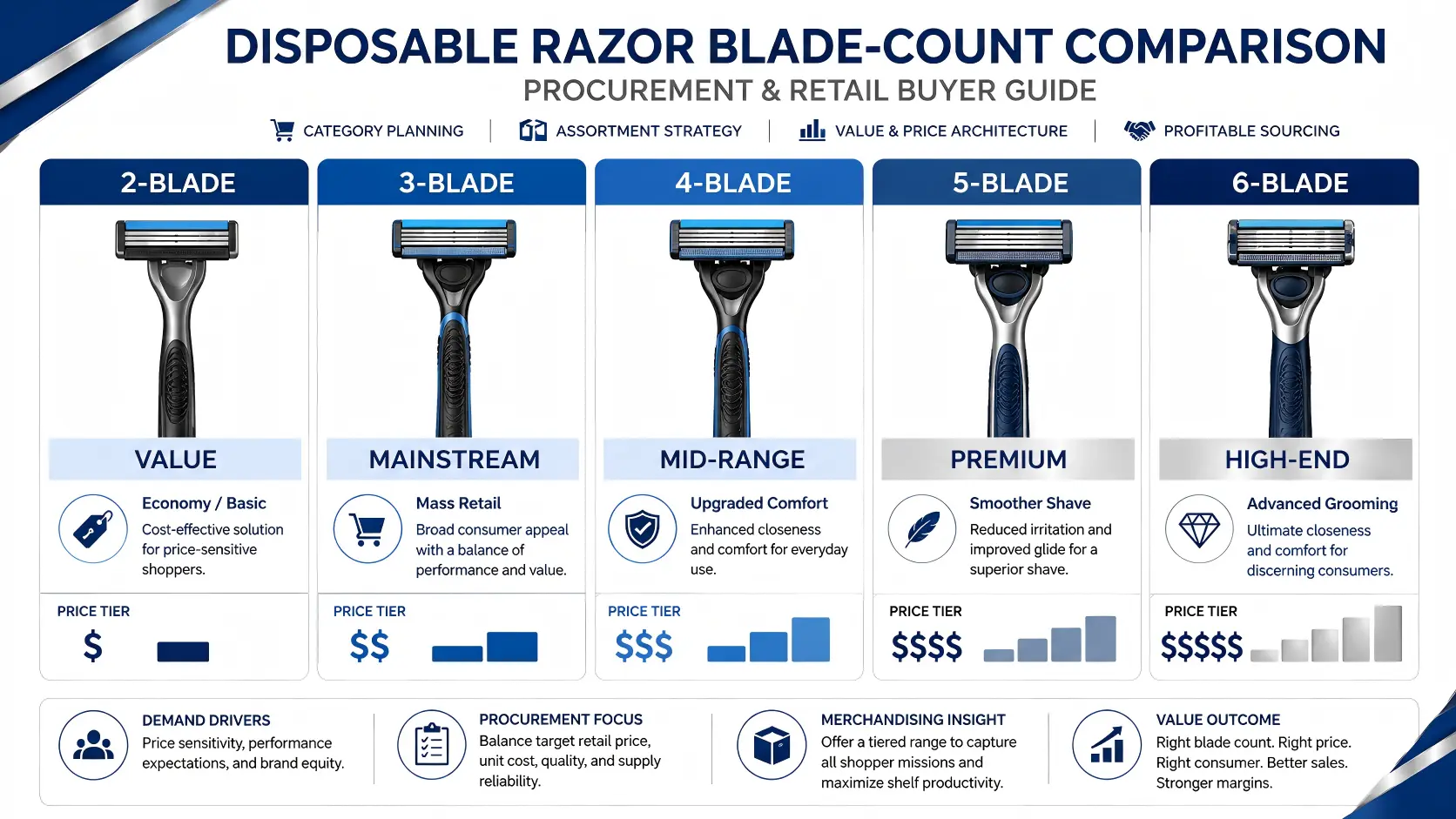
Blade count is one of the clearest retail signals on a disposable Razor pack. It helps buyers build a product ladder from entry-level value to premium private label. A 2-blade disposable Razor can work for basic supermarket multipacks. A 3-blade Razor fits mainstream family use. A 4-blade or 5-blade Razor can support better comfort claims. A 6-blade Razor may be used for premium differentiation when the target price allows.
The buyer should not choose blade count only for marketing. More blades usually require a larger head structure, better cap protection, stronger packaging fit, and clearer shelf explanation. If the product price is too low for the blade system, the margin may become weak. If the premium product uses poor handle design, customers may not believe the comfort claim.
Recommended Blade Tier Logic
- 2-blade disposable Razor: suitable for basic supermarket value packs and travel packs.
- 3-blade disposable Razor: suitable for mainstream daily shaving and family-use multipacks.
- 4-blade disposable Razor: suitable for mid-range drugstore grooming shelves.
- 5-blade disposable Razor: suitable for premium private label and women’s comfort positioning.
- 6-blade disposable Razor: suitable for stronger differentiation where margin and shelf price support it.
A reliable Manufacturer should help buyers balance shaving performance, cost, packaging size, and retail price point.
Handle Design and Grip Performance in Wet Use
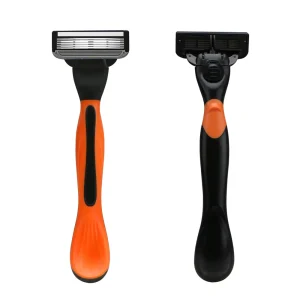
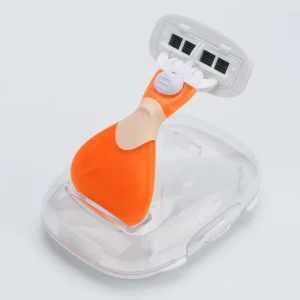
Disposable Razor handles affect both shelf perception and real user control. A very thin handle may reduce cost, but it can look cheap and feel unstable. A handle with texture, ergonomic curve, or TPR grip area can improve user confidence. In drugstores, where shoppers may compare private label products with national brands, handle appearance has commercial value.
From an engineering view, handle design must match the user scenario. Women’s disposable Razors often need better control for legs, underarms, and body curves. Men’s disposable Razors may need stable control around jawlines and beard areas. Family value packs need a simple and cost-efficient handle that still performs safely in a wet bathroom environment.
Handle Design Parameters
- Handle length: should support control without increasing pack size too much.
- Grip zone: textured plastic or TPR improves control under water and shaving foam.
- Neck strength: the connection between handle and head should resist bending.
- Surface finish: matte, glossy, or patterned finish should match the product tier.
- Color system: Customizable colors help separate men’s, women’s, value, and premium SKUs.
For OEM and ODM projects, handle design should be treated as part of product performance, shelf communication, and brand differentiation.
Packaging Design for Supermarket and Drugstore Display
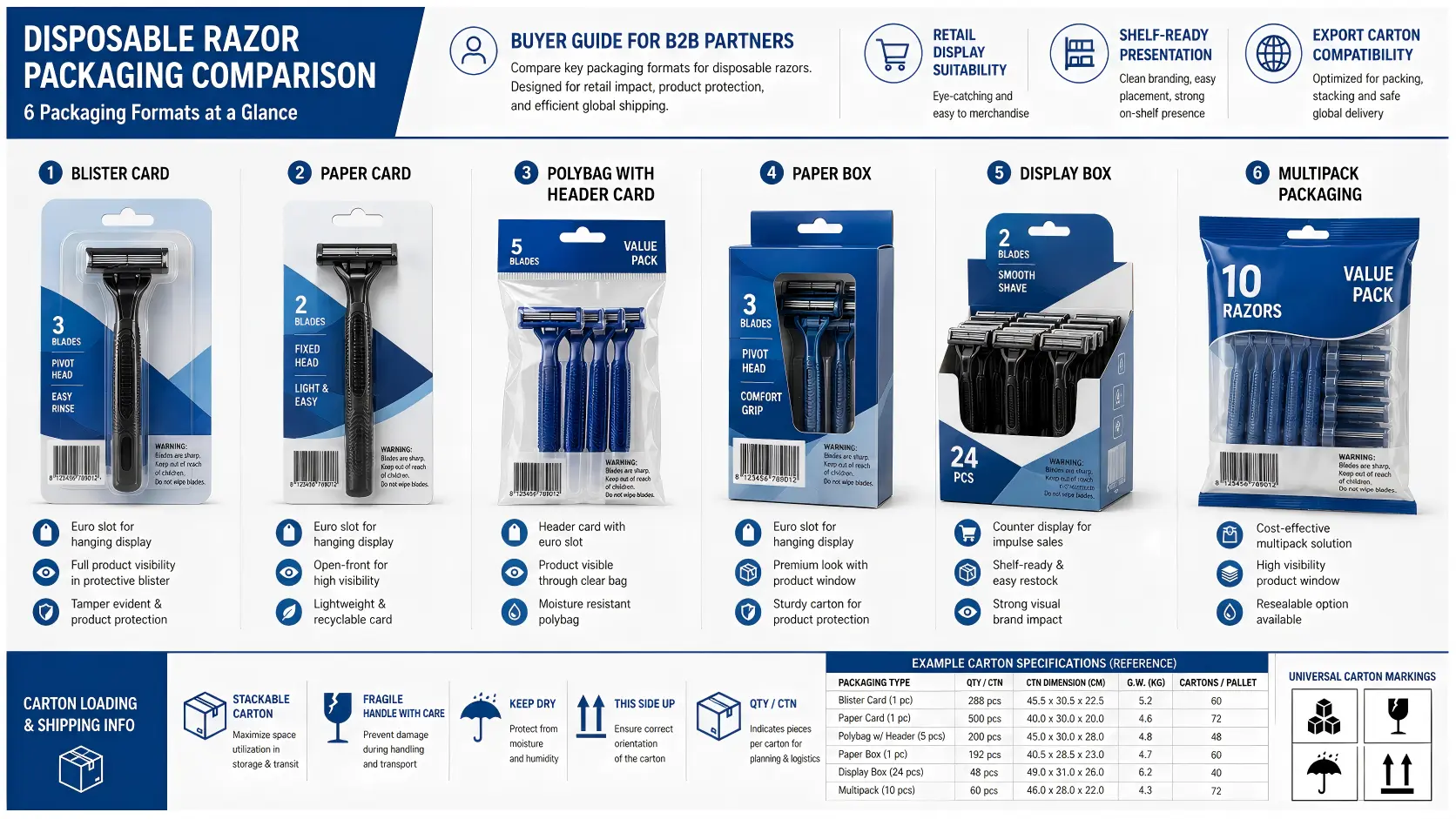
Packaging is a critical part of disposable Razor selection. In retail stores, the package must protect the product, explain the value, support shelf display, and survive the store merchandising topology. Weak packaging can make a good Razor look low value. Strong packaging can improve trust before the shopper opens the pack.
Common packaging formats include blister cards, paper cards, polybags with header cards, printed paper boxes, hanging display packs, and countertop display boxes. A supermarket may prefer value messaging, large pack quantity, and efficient carton loading. A drugstore may prefer cleaner visual hierarchy, comfort claims, and stronger private label appearance.
Retail Packaging Requirements
- Barcode readability: barcode should not be placed on folds, curved surfaces, or reflective areas.
- Hanging hole durability: blister cards should resist tearing on peg hooks.
- Blade visibility: clear windows or blister shells can help show product value.
- Warning text: safety warnings and usage precautions should be easy to locate.
- Carton strength: export cartons should protect retail packs during ocean shipment and warehouse stacking.
A professional Supplier should check packaging by real retail handling conditions, not only by artwork design.
Application Comparison for Retail Buyers
Disposable Razor buyers often manage several channel applications under one category. A supermarket value pack, a drugstore women’s grooming line, a premium private label product, and a travel promotion cannot use the same selection logic. Each has different cost, packaging, comfort, and replenishment requirements.
| Application Scenario | Recommended Razor Type | Key Technical Focus | Retail Benefit |
|---|---|---|---|
| Supermarket value multipack | 2-blade or 3-blade disposable Razor | Cost control, cap fit, carton efficiency | Competitive shelf price and high-volume turnover |
| Drugstore women’s grooming shelf | 3-blade to 5-blade disposable Razor | Wet grip, lubricating strip, soft color system | Better perceived value and repeat purchase |
| Premium private label line | 5-blade or 6-blade disposable Razor | Blade alignment, ergonomic handle, premium packaging | Higher margin and stronger brand differentiation |
| Travel and seasonal promotion | Compact 2-blade or 3-blade Razor | Small pack size, protective cap, easy display | Impulse purchase and promotional set compatibility |
| Wholesale drugstore replenishment | Mainstream disposable Razor | Repeat order consistency, barcode accuracy, carton marks | Lower complaint rate and easier inventory control |
This comparison shows why buyers should define the application first, then choose the Razor structure, packaging format, and customization level.
Drugstore Private Label Consistency
Drugstore private label buyers usually care about repeat purchase and category trust. A low-cost Supplier may win the first order, but if the second order has different handle color, weaker cap fit, rougher handle finish, or inconsistent packaging, the retailer may lose confidence. Consistency is not only a quality issue. It is a commercial requirement.
The Manufacturer should maintain approved samples, material records, color standards, packaging files, and inspection checkpoints. This is especially important for Customizable OEM disposable Razors because the private label brand depends on repeat visual and functional consistency. When a customer buys the same SKU again, the product should feel familiar.
Private Label Control Points
- Approved sample retention: both buyer and factory should keep confirmed product and packaging samples.
- Color standard: handle, cap, TPR, and packaging colors should match the approved reference.
- Blade head consistency: blade alignment, lubricating strip placement, and cap fit should remain stable.
- Artwork file control: barcode, claims, warning text, and country-of-origin information should not change accidentally.
- Batch traceability: carton codes and production records help handle complaints quickly.
A strong Supplier should provide stable quality across repeat orders, not only attractive samples for first approval.
Supermarket Value Packs and Cost Control
Supermarket buyers often need strong value perception. Shoppers compare unit price quickly, especially in disposable Razor multipack sections. However, cost reduction should not damage basic shaving performance, safety, or packaging reliability. A value pack still needs stable blade protection, smooth handle edges, correct cap fit, and readable packaging.
The best value pack uses a practical Razor structure, efficient packaging, stable production, and clear front-of-pack messaging. A very low-cost product may create hidden costs if it causes complaints, returns, or shelf rejection. A professional Manufacturer should help buyers engineer value instead of simply removing features.
Value Pack Engineering Priorities
- Pack quantity: 3-pack, 5-pack, 10-pack, or custom multipack according to shelf price target.
- Simple handle structure: reduces cost while maintaining safe control.
- Protective cap fit: prevents blade exposure during shelf handling and home storage.
- Carton loading efficiency: reduces freight cost and supports high-volume replenishment.
- Clear front message: blade count, pack quantity, and target use should be visible within seconds.
A supermarket disposable Razor should be economical, but it should not look unreliable.
Planogram Fit and Retail Display Engineering
Disposable Razor packaging must fit the retailer’s planogram topology. This means the pack width, height, hanging hole position, front-panel visibility, barcode placement, and case pack quantity should match the shelf system. A product that looks acceptable in a sample room may perform poorly if it wastes shelf space or hides key information.
The retail display environment includes bright lighting, neighboring brands, price labels, shelf crowding, and customer handling. The product must communicate quickly. If the blade count, pack quantity, and usage scenario are not clear, the shopper may choose another pack.
Planogram Design Checks
- Pack width: should fit target shelf spacing and peg hook layout.
- Front panel hierarchy: brand, blade count, pack quantity, and benefit should be readable.
- Hanging hole strength: should resist repeated handling in high-traffic stores.
- Barcode position: should support the electronic POS scanning topology without bending or reflection problems.
- Case pack quantity: should match retailer replenishment and warehouse handling needs.
A good OEM or ODM Razor project should check the retail shelf system before final packaging approval.
Safety, Hygiene, and Retail Compliance
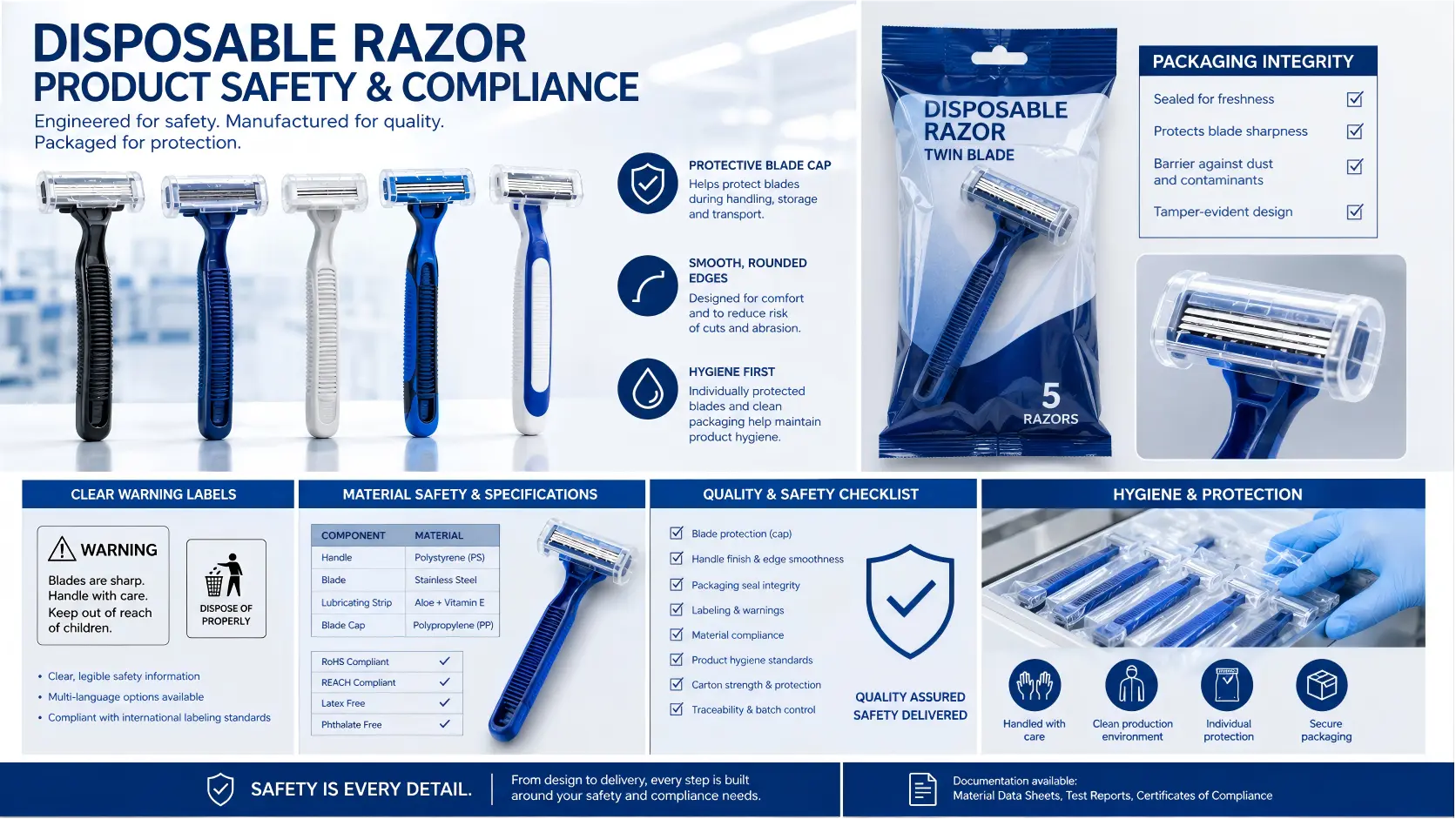
Disposable Razors are personal care products, so safety and hygiene are essential. Every Razor should include blade protection, smooth plastic edges, stable cap fit, and packaging that prevents accidental blade contact. When products are handled by many shoppers in a high-traffic retail environment, packaging protection becomes even more important.
Compliance requirements vary by market and retailer. Buyers may request material declarations, safety documents, packaging certificates, inspection records, or factory audit information. A Supplier serving supermarkets and drugstores should understand these requests before production starts.
Common Retail Safety and Compliance Items
- Protective cap: reduces blade exposure during shelf handling and home storage.
- Smooth handle edges: reduces plastic burr complaints.
- Packaging sealing: helps maintain hygiene and prevents missing items.
- Material documentation: may include plastic, blade, coating, lubricating strip, and packaging information.
- Factory audit support: important for larger retailers and private label programs.
A reliable Manufacturer should make safety part of product design, not only a final inspection item.
OEM and ODM Customization for Retail Differentiation
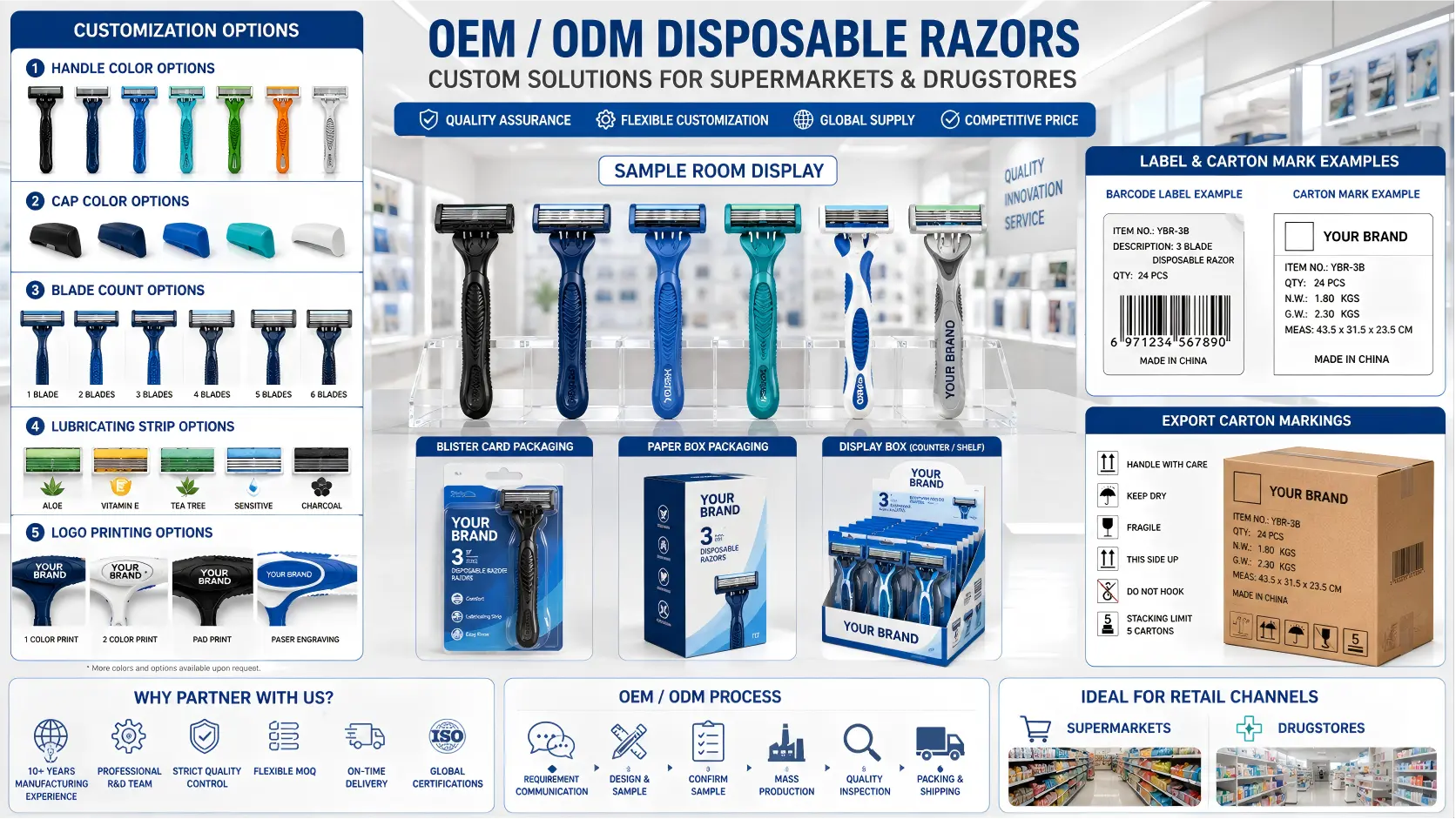
Supermarket and drugstore shelves can look crowded. Customizable OEM and ODM options help buyers create clearer product positioning. OEM customization may include handle color, cap color, packaging artwork, logo printing, pack quantity, and carton marks. ODM development may include exclusive handle design, new grip pattern, special packaging structure, or a unique women’s grooming set.
The buyer should decide whether speed or differentiation is more important. OEM is usually faster and more cost-efficient because it uses existing Manufacturer models. ODM creates stronger uniqueness, but it may require mold development, more sample rounds, higher MOQ, and longer approval time.
Customizable Elements
- Handle color, cap color, TPR grip color, and blade head color.
- Blade count options for value, mainstream, and premium positioning.
- Lubricating strip color and comfort claim direction.
- Blister card, paper box, polybag, display box, or multipack packaging.
- Logo placement on handle, packaging, label, or carton.
- Retail barcode, warning text, country of origin, and private label artwork.
A professional Supplier should separate simple OEM changes from ODM development that requires tooling, longer lead time, or additional testing.
Quality Control for Supermarket and Drugstore Disposable Razors
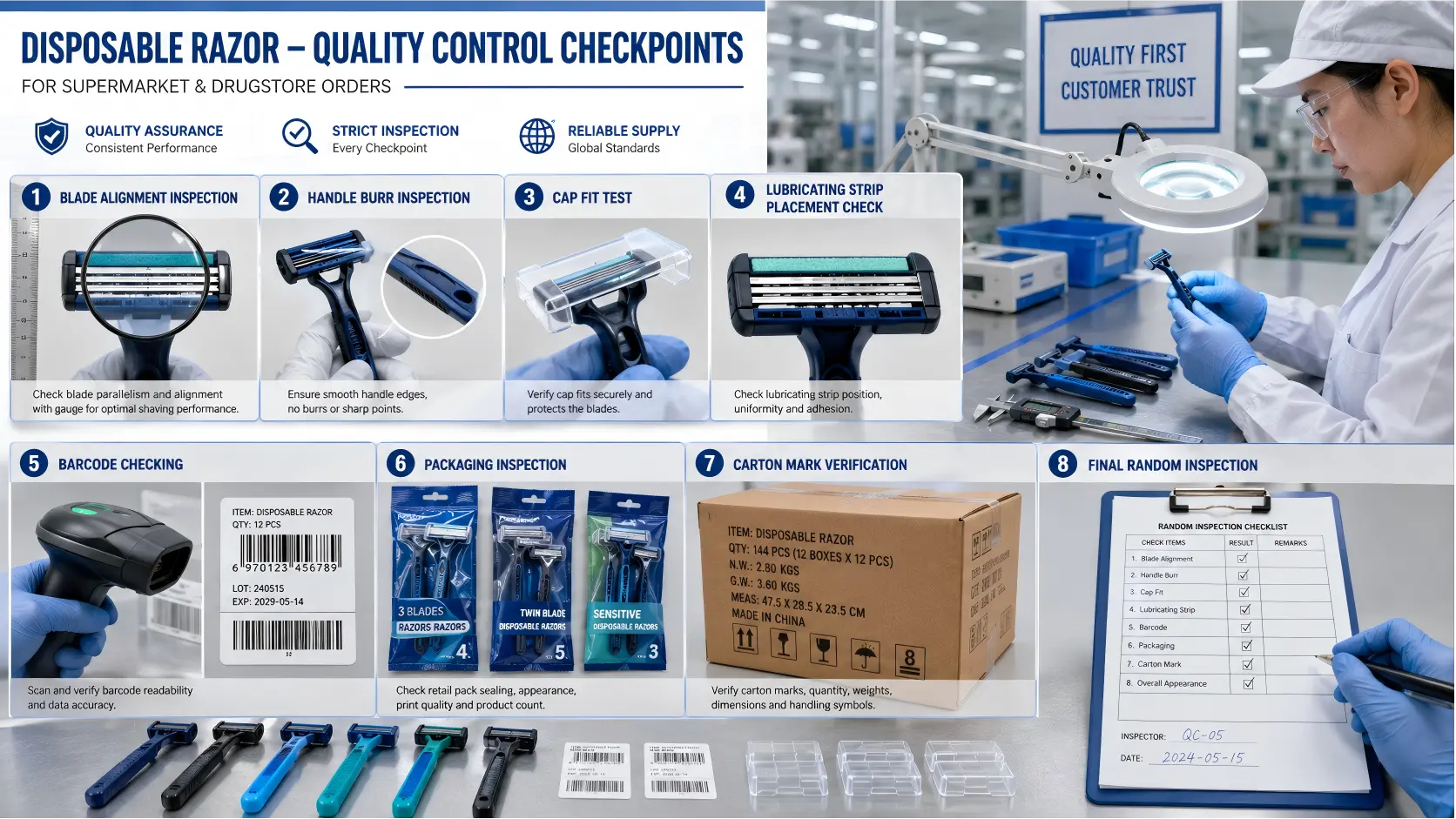
Retail disposable Razor quality must be stable because small defects become visible at scale. A supermarket or drugstore order may involve large quantities, multiple SKUs, and repeat replenishment. The Manufacturer must control both shaving function and retail packaging quality.
Quality control should include incoming materials, injection molding, blade assembly, lubricating strip placement, cap fitting, packaging, barcode checking, carton marks, and final random inspection. For private label buyers, approved samples should be used as the standard for repeat production.
Inspection Checklist
- Incoming material inspection: blade, plastic resin, TPR, caps, packaging paper, blister, and cartons.
- Blade assembly inspection: alignment, cartridge stability, edge protection, and lubricating strip placement.
- Handle inspection: burrs, deformation, color consistency, grip texture, and neck strength.
- Packaging inspection: artwork, barcode, quantity, sealing, hanging hole, and carton marks.
- Final random inspection: confirms product appearance, function, pack accuracy, and shipment readiness.
A Supplier that understands retail quality control can reduce return risk, shelf rejection, and brand complaint risk.
How to Evaluate a Disposable Razor Manufacturer
When selecting a disposable Razor Manufacturer for supermarkets and drugstores, buyers should look beyond unit price. The right Supplier should understand retail display, packaging strength, barcode accuracy, private label consistency, and repeat order control. A very low quotation may hide weak material control, unstable packaging, poor inspection, or limited OEM support.
Buyers should ask the Manufacturer to provide samples, packaging options, MOQ details, production lead time, quality control process, and customization capability. For ODM projects, the buyer should also ask about tooling time, sample rounds, material options, and approval milestones.
Supplier Evaluation Questions
- Can the Supplier recommend Razor structures for supermarket and drugstore channels?
- Can the Manufacturer support Customizable OEM packaging and private label artwork?
- Can the Supplier explain blade count, handle structure, cap fit, and packaging options?
- Does the Manufacturer control barcode, carton mark, and retail packaging inspection?
- Can the Supplier maintain consistency across repeat orders?
- Can the Manufacturer support ODM development for exclusive retail differentiation?
The best Supplier should help buyers build a retail-ready Razor program, not only ship products from a catalog.
Conclusion
Disposable Razors for supermarkets and drugstores require product design, shelf fit, packaging, safety, and supply stability. Work with Haward Razor for Customizable OEM and ODM disposable Razor solutions. Send your inquiry to discuss your retail channel, target price, and packaging needs.