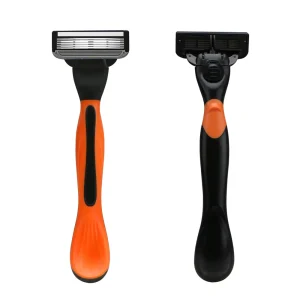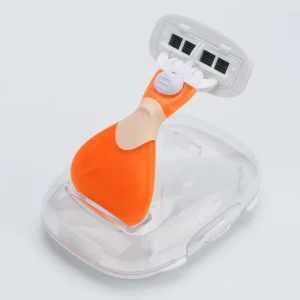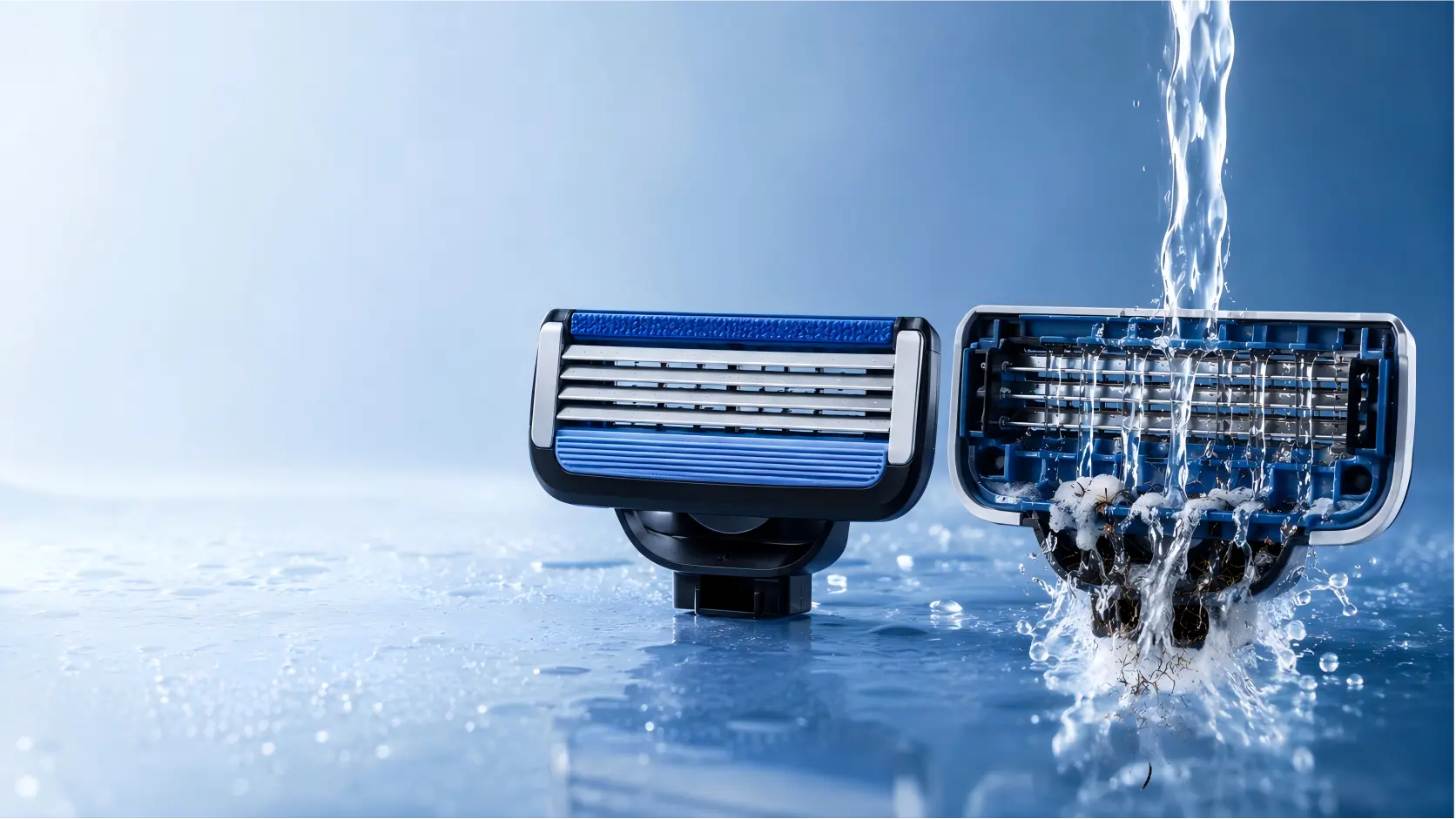
More blades and a larger lubricating strip may look premium, but neither prevents hair, shaving foam, skin debris, and hard-water residue from accumulating behind the blade stack. When the cartridge has restricted rinse paths, users must rinse repeatedly, strike the head against the sink, or continue shaving with partially blocked blades. The result can be increased drag, uneven cutting, extra passes, and negative reviews about short cartridge life. For an OEM buyer, this is more than a consumer inconvenience. Poor cleanability can expose weaknesses in the housing layout, blade spacing, molding accuracy, and product validation process. An open-back razor cartridge can address the blockage problem, but only when its water path, supporting ribs, blade geometry, pivot system, and structural strength are engineered as one controlled assembly.
An effective open-back razor cartridge uses unobstructed rear rinse channels to remove hair and shaving residue without weakening blade support or changing shaving geometry. Haward Razor develops Customizable OEM and ODM cartridges by balancing wash-through area, blade span, exposure, housing strength, lubrication, pivot response, and repeatable assembly quality.
To select the right architecture, buyers must look beyond a photograph of the cartridge back. The following sections explain how open-back geometry affects rinsing, shaving consistency, tooling, durability, testing, and Supplier qualification—and which parameters should be frozen before mass production.
1. What Is an Open-Back Razor Cartridge?
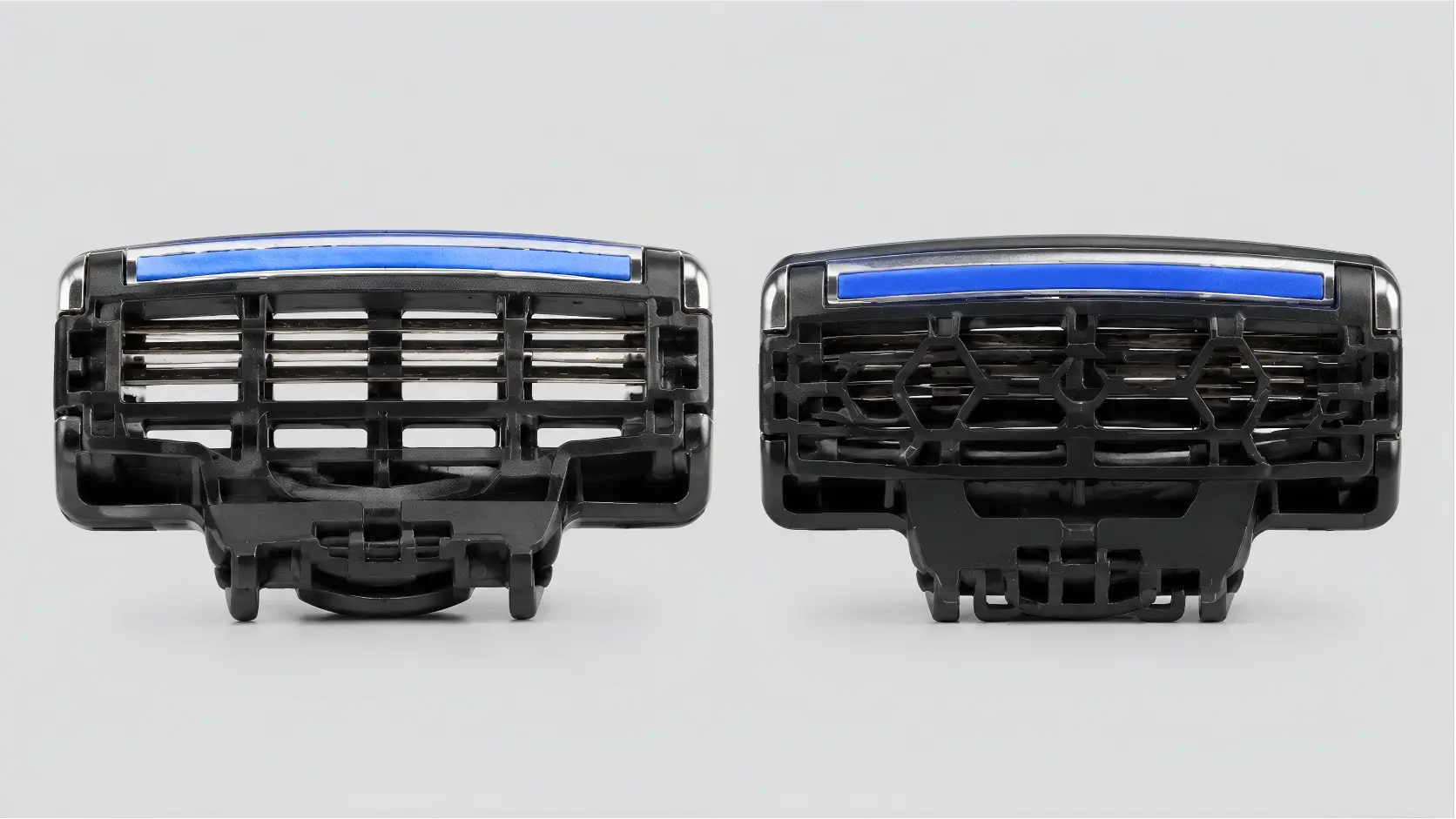
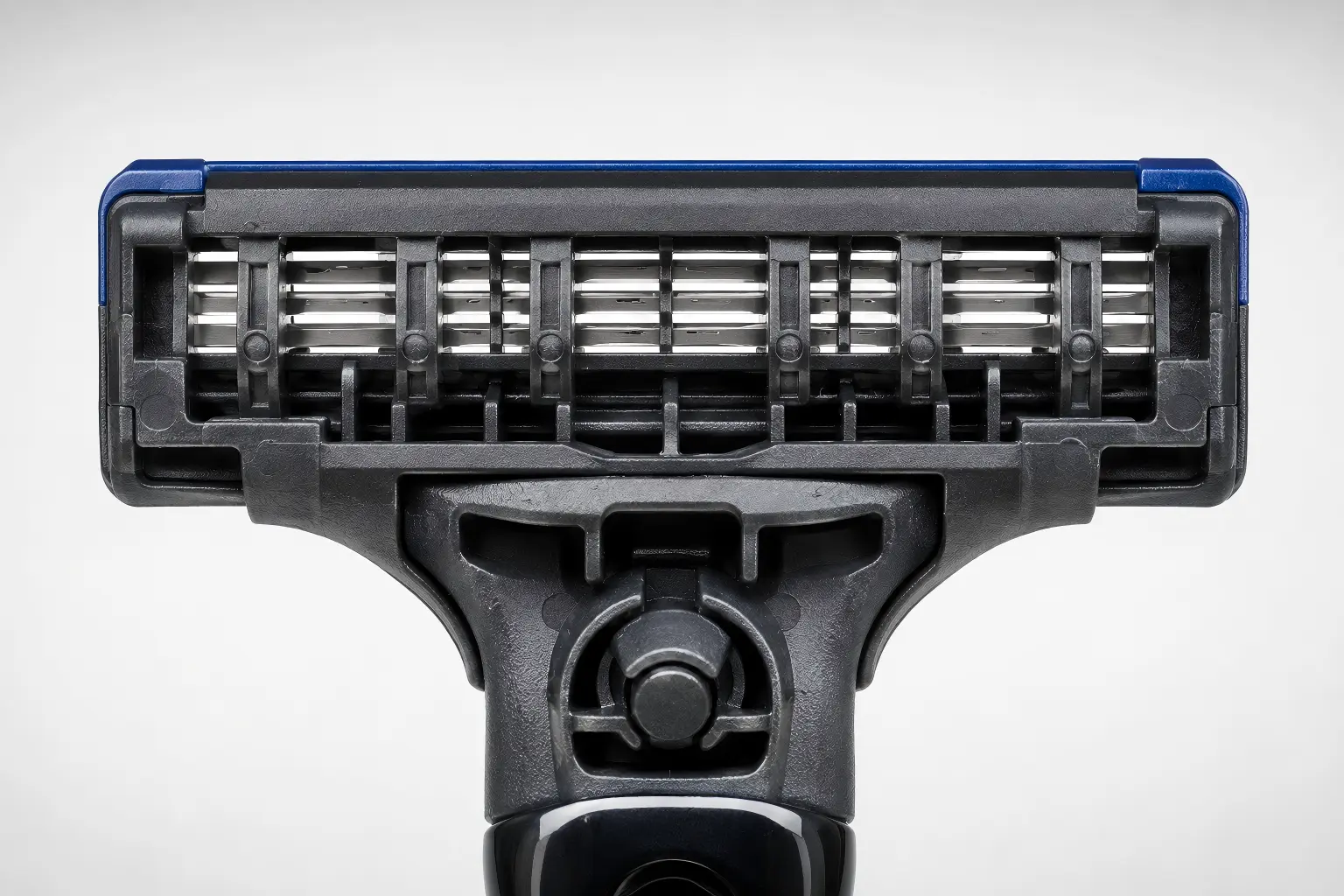
An open-back cartridge, also described as an open architecture or rinse-through cartridge, has openings behind the blade array that allow water and shaving debris to pass through the head. In a more enclosed design, rear walls, blade seats, connection components, or dense support ribs may restrict this flow.
Open-back does not mean removing every supporting structure. A functional cartridge still requires:
- Blade-support features that control blade location and vibration;
- Housing ribs that resist bending and twisting;
- A reliable cartridge-to-handle connection;
- Defined clearance around the pivot and release mechanism;
- Guard and cap surfaces that control skin contact;
- A stable position for the lubricating strip.
The engineering objective is therefore not the maximum possible opening. It is a controlled effective wash-through area that provides a continuous path from the front of the blade stack to the rear without creating weak sections, molding defects, or unstable blade geometry.
Haward Razor’s 2026 catalog, for example, identifies the D968 and D551L as open-architecture system razors and the D501L as a five-blade open-back system. The correct platform still depends on the target user, handle, blade count, packaging, and price level.
2. How Open-Back Geometry Improves Rinseability
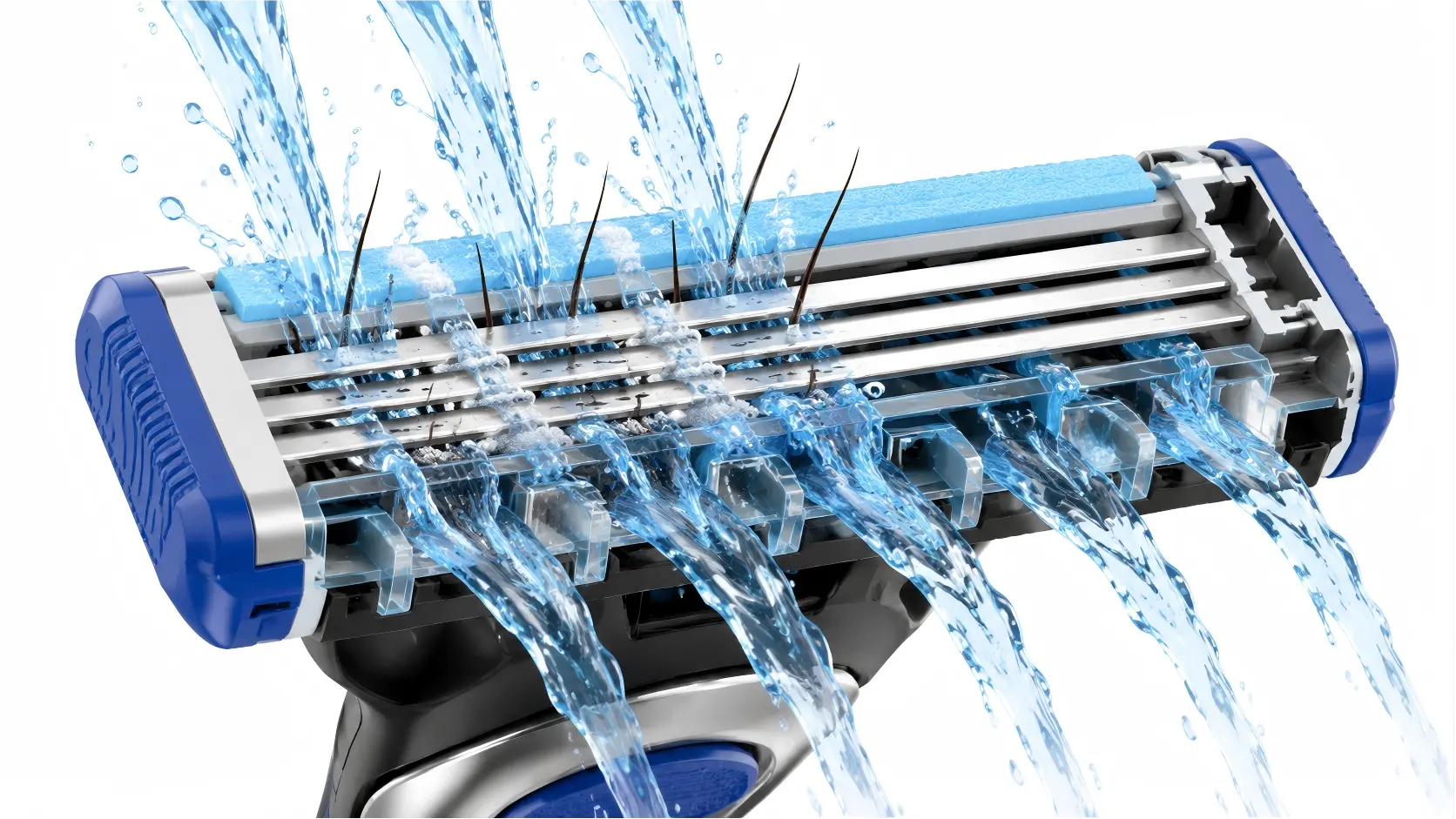
During wet shaving, the spaces between adjacent blades collect a mixture of cut hair, water, foam, sebum, and shaving product. If this material cannot move behind the blades, it can bridge across the openings and form a compact blockage. Dense facial hair, longer body hair, thick cream, and low water flow make the problem more visible.
An open rear section creates a shorter and less obstructed fluid-flow path. Water entering from the front can travel between the blades, carry loosened material through the housing, and exit at the back. Larger continuous openings also make it easier for users to direct water toward the affected area.
However, opening size alone does not determine cleaning performance. The Manufacturer must evaluate:
- Total open area and the narrowest flow restriction;
- Alignment between inter-blade spaces and rear openings;
- Dead zones behind housing ribs and blade supports;
- Angles that direct water through rather than away from the blade stack;
- Clearance around the handle connector and pivot structure;
- Whether long hairs can exit without wrapping around internal features.
Public razor patents show several engineering approaches. Some use a substantially open rear frame, while others use wash-through holes in blade supports. These examples demonstrate the importance of flow area but do not establish one universal industry specification.
| Published design example | Disclosed parameter | Technical purpose | Buyer interpretation |
|---|---|---|---|
| Open rear frame | Substantially open sections behind the blades | Allow deposited hair and shaving cream to leave the cartridge | Inspect the complete flow path, not only the visible opening |
| Intermediate blade wash-through holes | Approximately 5.0–7.0 mm² per hole in one patent example | Provide localized passages through supported blade structures | Patent values are references, not automatic project targets |
| Bottom blade wash-through holes | Approximately 8.0–13.0 mm² per hole in the same example | Increase discharge area where debris may accumulate | Validate against the actual housing, blade count, and soil load |
3. Does an Open Back Automatically Improve Shaving Performance?
Open-back architecture can support more consistent shaving by making the blade stack easier to rinse between strokes. A cleaner cartridge is less likely to retain large deposits that interfere with hair entry or cause users to repeat strokes over the same area. This is an indirect performance benefit, not proof that the cartridge cuts closer or feels smoother by itself.
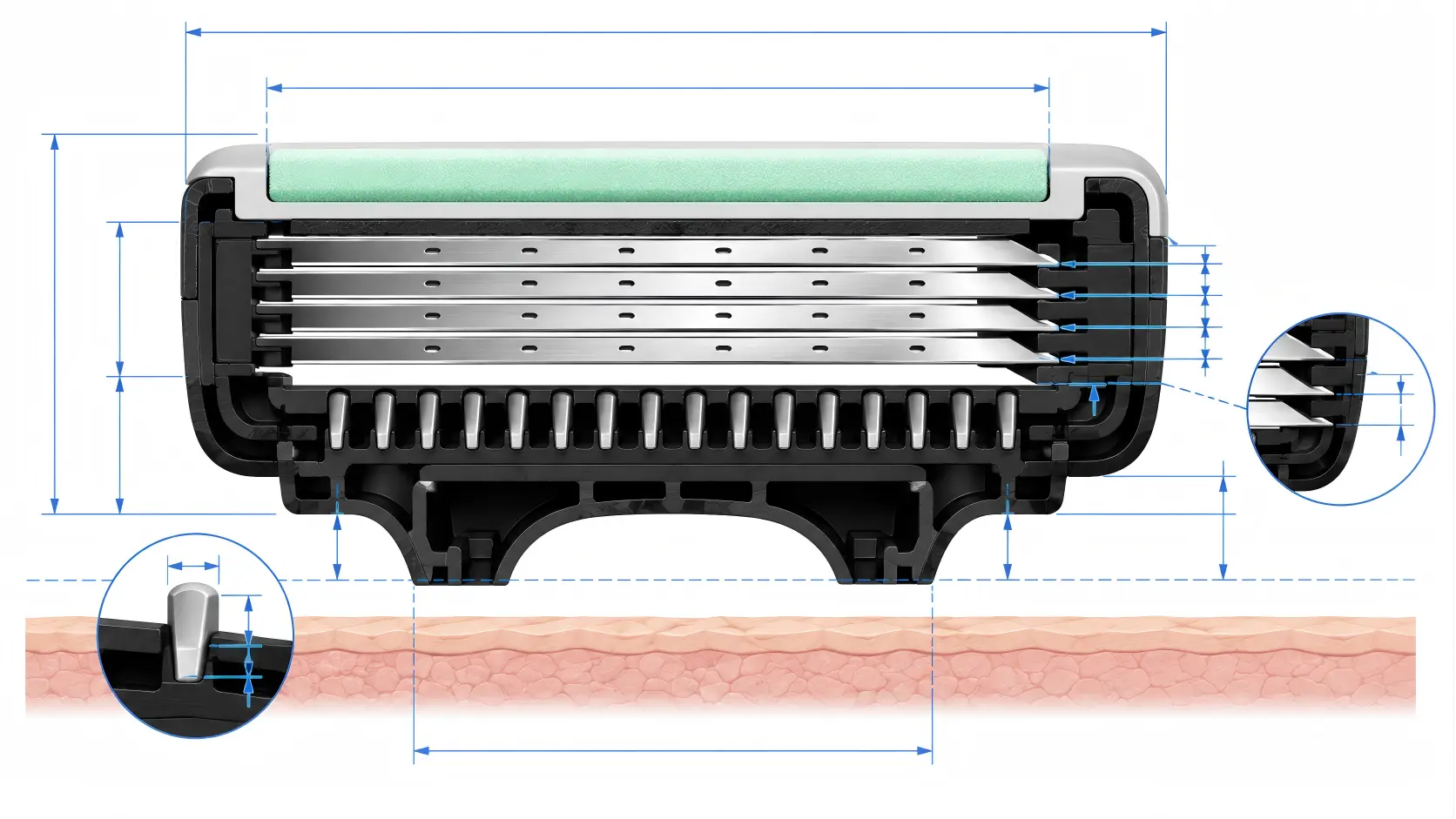
Front-side shaving behavior remains controlled by blade span, blade exposure, cutting-edge condition, guard geometry, cap position, lubrication, cartridge angle, and pivot force. Blade span is the distance between relevant skin-contacting or cutting features. Blade exposure describes the position of an edge relative to a reference plane formed by adjacent skin-contacting surfaces.
Published cartridge patents illustrate how sensitive these dimensions can be. Examples include a first-blade span of 0.5–1.5 mm and multi-blade inter-edge spans of approximately 0.95–1.15 mm. These values belong to specific patented constructions. They should not be copied into a new OEM design without testing.
Reducing span may limit the space into which skin can bulge, but closer spacing can also make rinsing more demanding. Increasing clearance may help debris movement but can change skin support and blade loading. A competent Supplier must optimize the front shaving geometry and rear cleaning geometry together.
4. Balance Open Area with Cartridge Strength
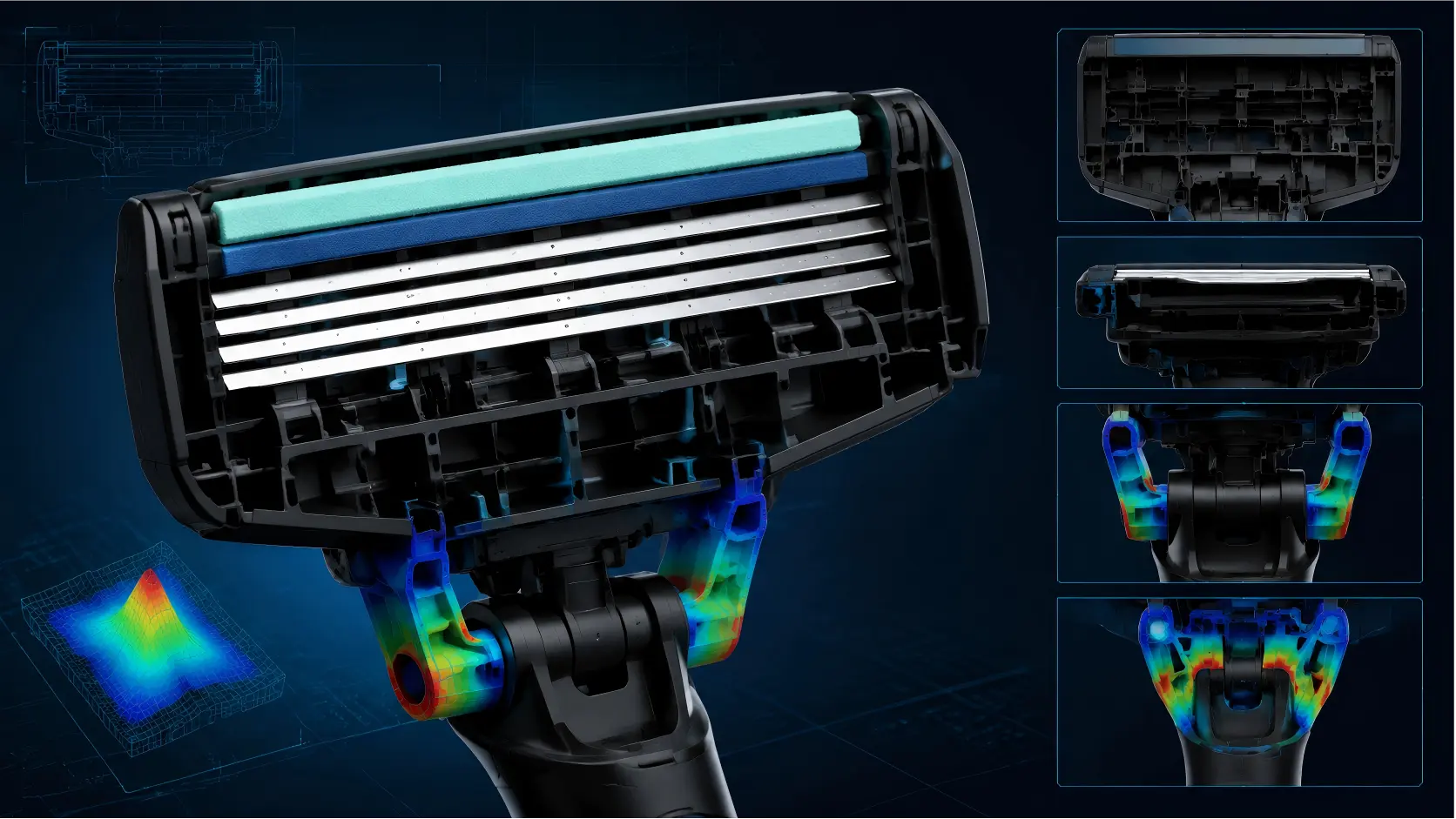
Removing plastic from the rear housing can reduce material use and improve access, but it also changes the cartridge’s load path. Thin ribs may deform during molding, assembly, packaging, transport, or shaving. Excessive flexibility can alter blade position or cause the connector and pivot features to move outside their intended tolerances.
The Manufacturer should use a combination of tolerance analysis, molded-part measurement, assembly trials, and mechanical testing. Critical areas include:
- Ribs supporting blade seats and welded blade assemblies;
- Clip, stake, weld, or retention locations;
- The interface between the housing and cartridge connector;
- Pivot arms, return elements, and release-button contact points;
- Corners where stress can concentrate during cartridge installation;
- Long flow openings that may warp after ejection from the mold.
Glass-filled materials can improve stiffness in some components, while polypropylene, ABS, or other engineering polymers may be selected according to flexibility, molding, appearance, chemical resistance, and cost requirements. Material selection cannot be separated from the rib layout and gate design.
A Customizable cartridge may also require color changes. Different pigments and masterbatch additions can influence shrinkage, surface appearance, or processing conditions. The OEM specification should therefore prohibit unapproved resin, filler, colorant, and recycled-content changes through a formal engineering change notice.
5. Control Molding, Blade Assembly, and Dimensional Variation
Open structures can be more sensitive to injection-molding variation. Narrow ribs, flow intersections, weld lines, gate locations, and uneven cooling can produce short shots, flash, sink marks, twist, or local weakness. A visually acceptable housing may still position the blades or handle connection incorrectly.
Before production release, the Supplier should identify critical-to-quality characteristics (CTQs), including housing flatness, blade-seat height, opening dimensions, blade-edge position, cartridge width, connector fit, pivot travel, and lubrication-strip location. Measurement fixtures must reference stable datums rather than flexible cosmetic surfaces.
Blade installation also requires control. Depending on the platform, blades may be mounted on supports, spot welded, retained with clips, or fixed by housing features. The assembly process should prevent:
- Uneven blade exposure across the cartridge width;
- Blade tilt or lateral displacement;
- Loose blades and abnormal vibration;
- Weld deformation or incomplete retention;
- Plastic flash entering the rinse path;
- Housing stress that appears only after aging or transport.
A golden sample is useful, but it cannot replace numerical drawings and test methods. The OEM buyer and Manufacturer should freeze the BOM, drawing revision, tolerance plan, defect library, test fixtures, and approved sample before the pilot run.
6. Consider Drying, Residue, and Wet-Environment Durability
Improved drainage can reduce trapped water and make the cartridge easier to inspect, but an open back does not make a razor sterile, corrosion-proof, or maintenance-free. Water may still remain around blade supports, weld points, lubrication materials, clips, or the handle connection.
The development team should test the assembled product with the actual materials used in production. Relevant variables include water hardness, chloride content, shaving-product chemistry, rinse temperature, storage orientation, and time between uses. Blade substrate, edge coating, weld quality, and exposed metal surfaces can all influence repeated-use durability.
The cartridge should also be evaluated after:
- Repeated wet-dry cycling;
- Exposure to representative shaving foam, gel, soap, and oil;
- Storage in a wet bathroom or enclosed travel case;
- Rinsing followed by incomplete shaking or drying;
- Contact with hard-water deposits;
- Transport aging in the intended primary packaging.
Claims such as “more hygienic,” “self-cleaning,” or “longer-lasting” require evidence from a defined test method and relevant consumer-use study. For most B2B programs, “easy-rinse open-back design” is a more defensible claim when comparative rinse testing confirms the result.
7. Validate Cleaning Performance with a Repeatable Test
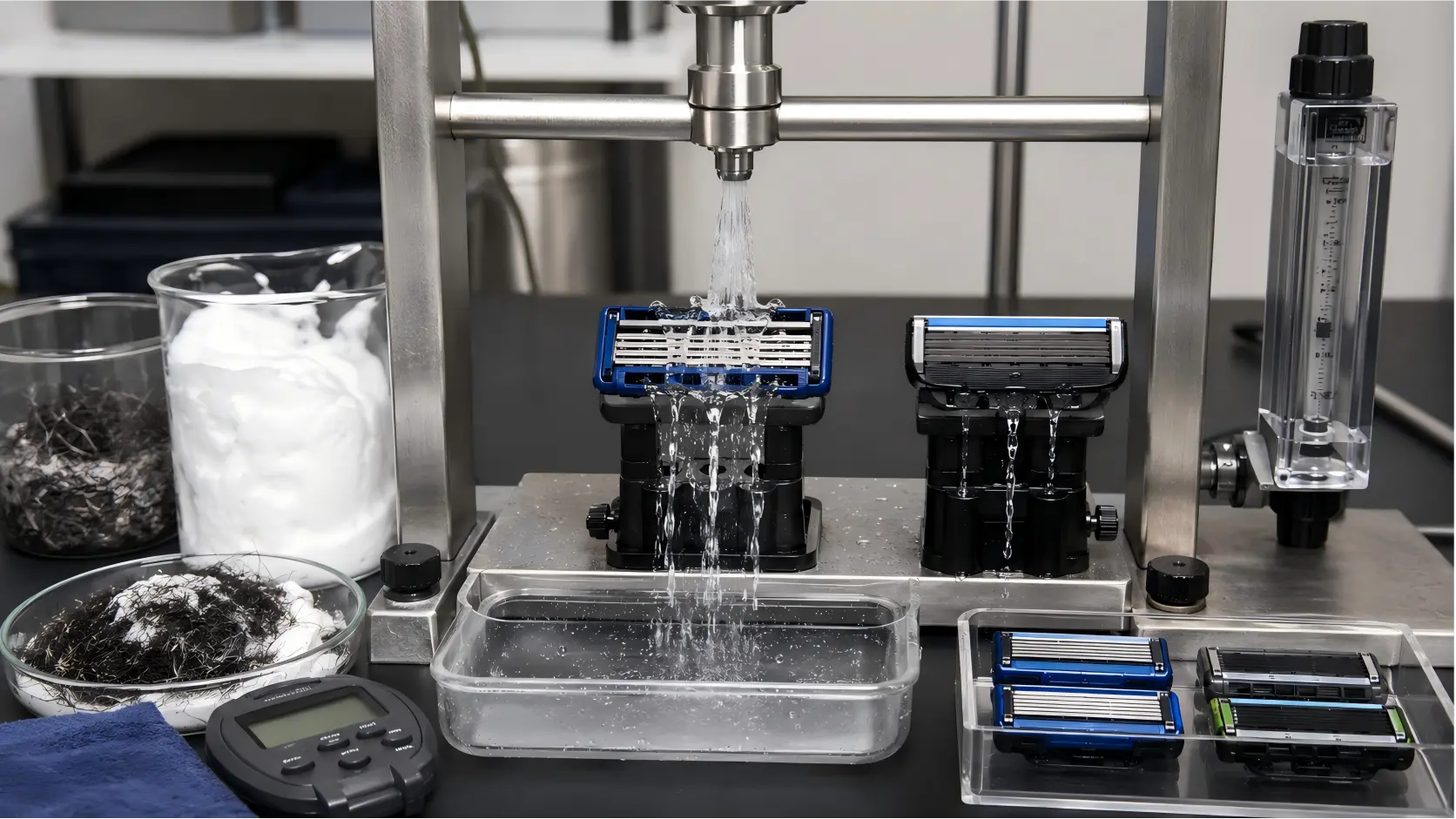
There is no single universal rinseability standard that automatically approves every open-back razor cartridge. The OEM buyer and Supplier should create a repeatable internal method that represents the target consumer. Testing only with clean water is insufficient because real blockage contains hair and viscous shaving products.
A useful method applies a controlled amount of standardized soil to the cartridge, performs defined shaving or loading strokes, and rinses the head at a fixed flow, temperature, distance, orientation, and time. The team then measures retained mass, blocked area, residual hair count, or image-based cleanliness.
| Verification item | Illustrative development condition | Measured output | Acceptance approach |
|---|---|---|---|
| Rinseability | Controlled hair-and-foam load; water at 2.0 ± 0.2 L/min for 15 seconds | Percentage of soil removed or residual mass | Set against an approved benchmark cartridge |
| Low-flow cleaning | Repeat at 1.0 ± 0.1 L/min | Blocked blade area and retained hair | Project-specific limit based on target market use |
| Dry-down assessment | Rinse, shake once, and store at a defined angle | Visible pooled water and drying time | Compare open-back and control samples |
| Cartridge retention | Pull or push in the specified connection direction | Peak release force in newtons | Approved design range with no accidental release |
| Pivot endurance | Repeated full-travel cycles under a defined load | Return position, noise, damage, and pivot force | No functional failure or out-of-range movement |
| Blade alignment | Optical or fixture-based inspection across the head | Edge position, parallelism, span, and exposure | Drawing tolerances and approved golden sample |
The values above are illustrative starting conditions, not an industry standard. Final limits must be based on cartridge geometry, benchmark data, user profile, and risk. Test several production lots, not only hand-selected development samples.
8. Specify Open-Back Performance in an OEM or ODM Project
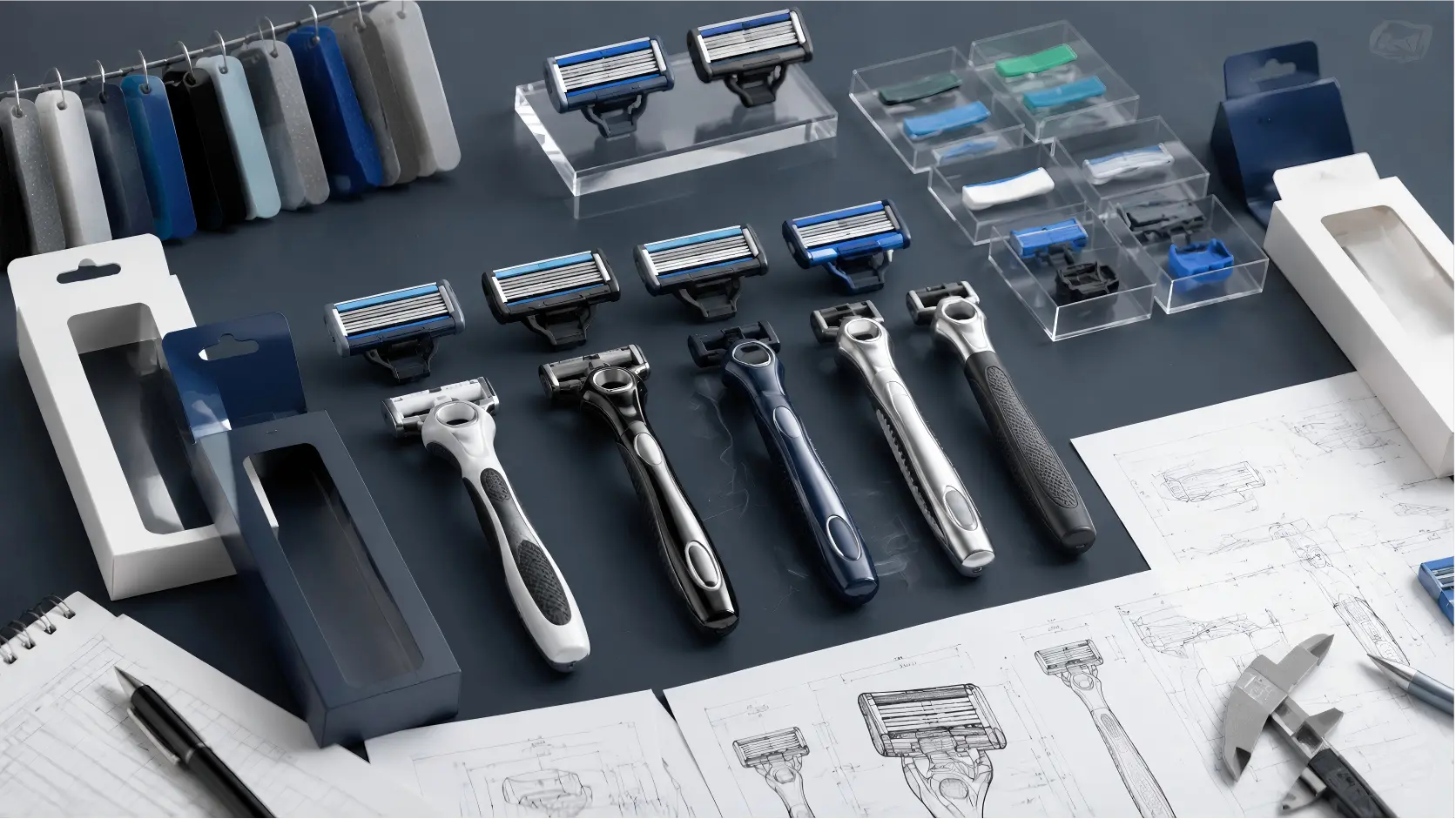
“Open-back cartridge” is too broad for a purchase specification. Two Suppliers can use that phrase while offering very different opening areas, rib patterns, blade spacing, cleaning behavior, and connection systems. Buyers should convert the marketing term into measurable requirements.
A technical request for quotation should define:
- Target blade count, user group, body area, hair type, and shaving medium;
- Reference cartridge and expected rinsing performance;
- Blade geometry, coating, support structure, and lubrication requirements;
- Cartridge dimensions, handle compatibility, pivot range, and release force;
- Approved resin, color, finish, logo, and packaging configuration;
- Rinse test, mechanical tests, wet-dry test, and dimensional inspection plan;
- Golden samples, pilot-run quantity, traceability, and change-control rules.
ODM Platform Adaptation
An ODM program can use an existing, validated open-back platform while changing the handle, color, logo, lubrication-strip formula, cartridge count, and retail packaging. This route generally reduces tooling risk and development time. The buyer should confirm which features are already fixed and which are genuinely Customizable.
Original OEM Development
A new OEM cartridge allows deeper control over blade count, rear openings, guard, cap, connector, and appearance. It also requires mold-flow review, prototypes, assembly fixtures, pilot production, rinseability correlation, user testing, and higher tooling investment. Tool ownership and intellectual-property boundaries should be agreed before development starts.
9. Audit the Manufacturer Beyond the Finished Sample

A polished sample does not prove that the Supplier can hold blade geometry and rinse performance across mass-production lots. The audit should follow the complete process from incoming blade and resin inspection through molding, welding, assembly, lubrication-strip installation, handle connection, packaging, and final release.
Recommended audit and approval points include:
- Incoming quality control for blades, resin, masterbatch, strips, and metal parts;
- Mold maintenance, cavity identification, and process-parameter records;
- Blade-edge protection and controlled handling during assembly;
- Spot-welding or retention-process monitoring;
- Optical or fixture-based blade-alignment inspection;
- Lot traceability from raw materials to packed cartridges;
- Corrective and preventive action (CAPA) for rinse, assembly, and cosmetic defects;
- Final sampling under the agreed defect classification.
ISO 2859-1:2026 provides AQL-indexed sampling schemes for inspection by attributes. The buyer must still define inspection level, AQL, defect classes, and critical-defect rules. Acceptance sampling cannot compensate for an unstable molding or blade-assembly process.
Choose an Open-Back Design That Performs Beyond the Product Photo
Open-back architecture is valuable when cleaning access, shaving geometry, strength, and production control are validated together. Send Haward Razor your benchmark, blade count, target user, handle, packaging, and market requirements to receive a Customizable OEM or ODM cartridge proposal with defined testing and quality controls.