A private label Razor portfolio often grows one request at a time: a new blade count for one retailer, another handle for a promotion, six colors for regional buyers, and separate packs for every channel. Sales sees choice, but procurement inherits fragmented forecasts, repeated MOQs, duplicate components, artwork revisions, and finished goods that cannot be redirected when demand changes. The crisis appears when a high-volume launch needs capacity while cash remains trapped in low-volume cartridges and obsolete packaging. Buyers then choose between stock-outs, airfreight, markdowns, or write-offs. Razor SKU consolidation resolves the conflict by reducing cartridge and connection platforms, preserving deliberate handle and color differentiation, and postponing final packaging decisions until demand becomes clearer.
A qualified Supplier should offer a validated shared razor platform, controlled interface matrix, component-level MOQ, late-stage color and packaging options, traceable change control, and SKU profitability review. Haward supports razor SKU consolidation through Customizable OEM and ODM 3-, 5-, and 6-blade platform families without treating every market variant as a new mechanism.
Portfolio managers, retailers, brand founders, and engineering wholesalers should continue. The following sections reveal how experienced Razor buyers separate real consumer choice from hidden component duplication, calculate platform economics, protect compliance, and negotiate variety without rebuilding the supply chain for every new SKU or weakening margin and product availability.
Define a Shared Platform Before Counting Finished SKUs
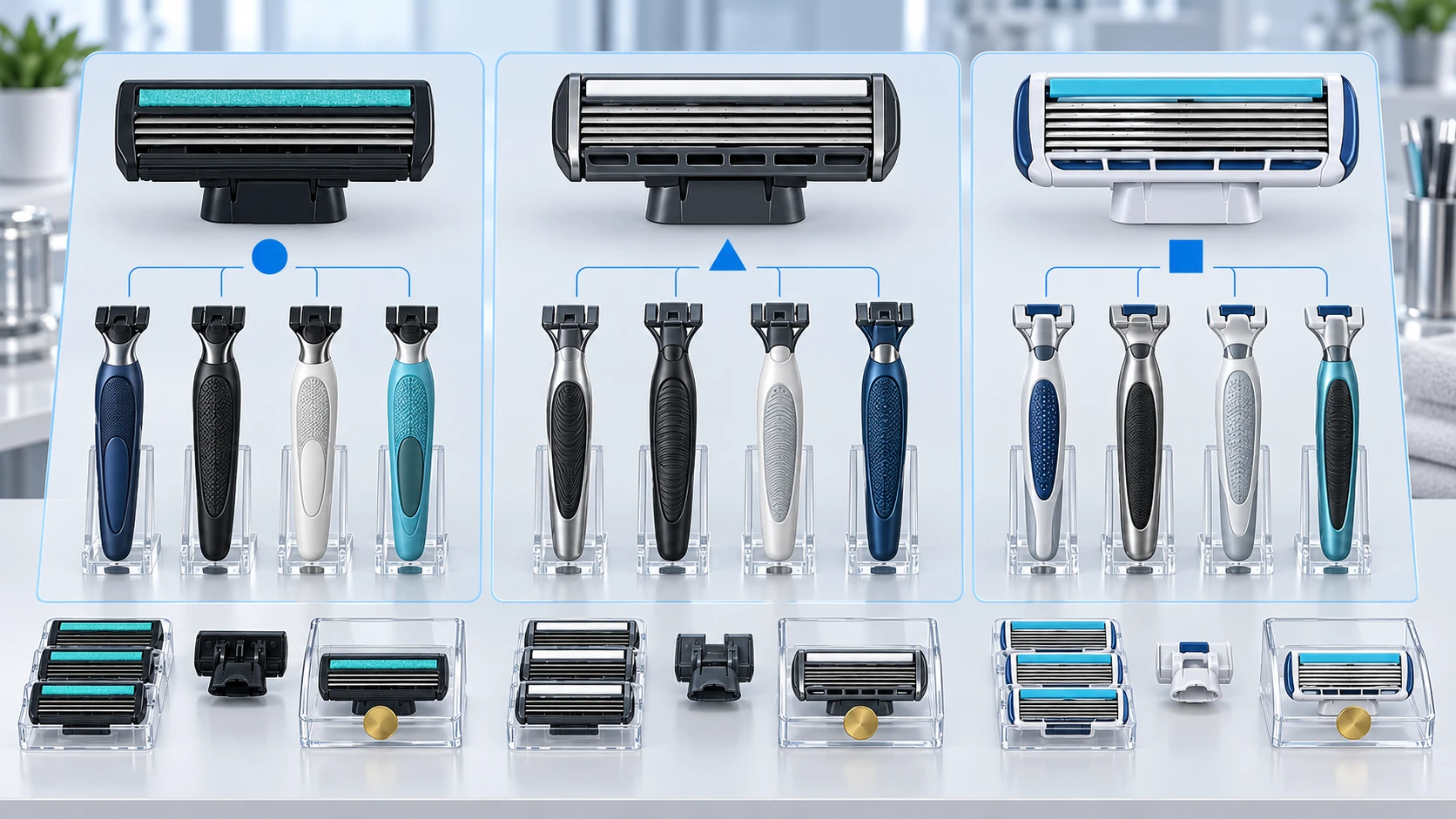
Separate the Mechanical Core from Commercial Differentiation
A shared razor platform is a controlled family of common technical elements. It may include the blade-carrier architecture, cartridge housing, pivot interface, release geometry, handle connector, manufacturing process, inspection fixture, and approved material set. Handle shape, grip texture, resin color, decorative finish, logo, pack count, and artwork can then vary within documented boundaries.
The platform definition should answer five questions:
- Which cartridges and handles have a validated mechanical connection?
- Which components are physically identical across finished SKUs?
- Which dimensions, materials, and tests are platform-critical?
- Which changes require a new qualification rather than an artwork approval?
- Which markets or channels need a commercially separate item number?
Do not assume that every 3-, 5-, and 6-blade head fits every handle. Haward’s families can support multiple handle and color choices, but the Manufacturer and buyer must approve an interface compatibility matrix. This distinction is central to razor SKU consolidation: standardize invisible engineering where interchangeability has been proven, then create visible differentiation only where the customer can recognize and value it.
Calculate the True Complexity Behind Each New Variant
Count Components, Setups, Documents, and Inventory Positions
One color extension rarely creates only one task. It may require a resin masterbatch, color standard, handle molding setup, printed artwork, barcode, case label, inspection record, forecast, safety stock, and retailer data submission. A new cartridge platform adds more: blade components, tooling, gauges, assembly settings, performance validation, spare parts, and Supplier capacity allocation.
Use a complexity ledger before approving a variant:
- Engineering: unique drawings, BOMs, molds, fixtures, and test methods;
- Procurement: material MOQ, lead time, approved source, and price-break loss;
- Operations: setup hours, line clearance, yield risk, and changeover frequency;
- Inventory: raw, work-in-process, finished-goods, packaging, and obsolete-stock exposure;
- Commercial: GTIN, artwork, forecast, listing fee, margin, and channel exclusivity.
The simple multiplication platforms × handles × colors × packs × markets shows theoretical exposure, not the number buyers must launch. If three platforms, four handles, five colors, three packs, and two markets are all combined, the portfolio could create 360 finished configurations. A disciplined private label SKU reduction process approves only combinations with a defined role and volume case.
| Illustrative Portfolio Measure | Fragmented Architecture | Consolidated Architecture | Commercial Effect |
|---|---|---|---|
| Cartridge platforms | 8 | 3 | Fewer tooling, gauge, and qualification families |
| Visible handle/color choices | 6 | 6 | Consumer-facing segmentation remains available |
| Active finished SKUs | 48 | 24 | Forecast and packaging demand becomes less fragmented |
| Illustrative annual volume per SKU | 20,000 units | 40,000 units | Stronger MOQ absorption at equal total volume |
| Artwork and barcode records | 48 sets | 24 sets | Lower maintenance and obsolescence exposure |

This is a buyer-planning example, not a universal savings claim. Actual results depend on sales concentration, pack structure, MOQ, transition cost, and whether discontinued items can be sold through.
Assign a Clear Market Role to the 3-, 5-, and 6-Blade Families
Use Blade Count as a Portfolio Tier, Not a Design Collection Habit
A practical cartridge platform strategy starts with price architecture and channel purpose. A 3-blade Razor may support an accessible core offer, travel line, promotional pack, or price-sensitive retailer. A 5-blade system can occupy the mainstream premium tier and carry the broadest set of handles, colors, and pack counts. A 6-blade system may serve as the flagship proposition for selected channels or gift programs.
| Platform Family | Possible B2B Role | Suggested Variant Discipline | Main Risk to Control |
|---|---|---|---|
| 3-blade platform | Value, travel, promotion, or entry tier | Limit packs; reuse proven handle and colors | Price overlap with disposable ranges |
| 5-blade platform | Mainstream premium and volume anchor | Carry the widest justified handle/color range | Variant proliferation |
| 6-blade platform | Flagship, gifting, or channel-exclusive tier | Launch selectively and review repeat demand | Low-volume premium inventory |
These are planning roles, not performance claims. Final positioning depends on validated product specifications, target cost, consumer research, and market rules. The key is to avoid two cartridges performing the same portfolio job at nearly the same retail price. Every platform should have a buyer-approved role, price corridor, target channel, annual volume, and exit rule.
Postpone Differentiation Until Demand Becomes More Certain

Build Common Modules First and Finish Variants Later
The strongest supply-chain benefit comes from late-stage differentiation. Instead of building every finished Razor against a long-range color-and-pack forecast, the Supplier can hold agreed common components and convert them after a firm release. Possible common stock includes qualified cartridges, unprinted inner trays, standard connectors, or neutral components that remain usable across several private label SKUs.
A postponement plan should define:
- which modules may be produced against forecast;
- which colors require dedicated resin or minimum molding runs;
- the last responsible point for logo, decoration, and packaging selection;
- maximum common-component and finished-goods inventory;
- conversion lead time after a firm order; and
- ownership of excess materials when demand falls.
Do not postpone a decision beyond the process that creates it. A molded-in handle color must be fixed before molding. Pad printing or laser marking may be scheduled later. Printed blister cards and market-language cartons generally become dedicated inventory once produced. The Manufacturer should map these decoupling points in the quotation so Customizable choices do not become hidden delivery risk.
Negotiate MOQ by Component Family, Not Only by Finished SKU
Separate Platform Volume from Color, Decoration, and Packaging Commitments
A single finished-SKU MOQ often conceals several economic batch sizes. Cartridge assembly, handle molding, color mixing, logo printing, blister sealing, carton printing, and case packing may each have different setup costs and minimum runs. A capable Supplier should disclose the commercial logic without necessarily revealing confidential conversion costs.
For a shared razor platform, negotiate four layers:
- Annual platform volume: total 3-, 5-, or 6-blade commitment supporting capacity and component purchasing.
- Handle-family volume: aggregate demand for a common tool and approved connection.
- Color or decoration batch: the minimum efficient run for each appearance variant.
- Release quantity: the shippable SKU quantity by pack, language, and destination.
This structure can let an OEM buyer combine cartridge demand across several branded handles while keeping packaging releases smaller. The agreement must still specify forecast liability, material ownership, aging limits, price breaks, cancellation rules, and the treatment of unused labels or color resin. Without those terms, razor SKU consolidation may simply move excess stock from the retailer’s warehouse to the Manufacturer.
Use Sales and Variability Data Before Deleting an SKU
Combine ABC Value with XYZ Forecastability and Strategic Role
Revenue alone is not enough. A low-volume SKU may protect a strategic retailer, complete a price ladder, or generate high contribution margin. A high-revenue SKU may still create poor cash flow if it requires excessive promotions, unique packaging, or unstable forecasts. Buyers should review at least 12 months of sales where available and separate launch noise from repeat demand.
- ABC value: rank revenue, gross margin, or contribution after logistics cost.
- XYZ variability: classify stable, seasonal, and erratic demand.
- Commonality: measure the percentage of components shared with retained SKUs.
- Substitution: estimate whether demand transfers to another Razor or disappears.
- Exit cost: include packaging, materials, retailer penalties, and markdowns.
Research on unsuccessful SKU rationalization warns that apparent redundancy may actually reflect weak item governance rather than too much meaningful variety. Therefore, check duplicate codes, dormant items, superseded artwork, and pack hierarchy before discontinuing products. A private label SKU reduction decision should combine data with a commercial review by sales, procurement, operations, finance, and quality.
Keep Commercial SKUs Distinct Even When the Hardware Is Shared
Control GTINs, Artwork, Claims, and Destination Compliance
Platform consolidation simplifies engineering; it does not eliminate commercial identification. GS1’s GTIN Management Standard states that product variations such as distinct colors may require unique GTINs when trading partners need to identify and order them separately. Each packaging hierarchy can also require its own identifier. The retailer and brand owner must apply the current rule to the exact variant.
Maintain a controlled SKU master containing:
- internal SKU, customer item number, GTIN, and pack hierarchy;
- approved platform, cartridge, handle, color, decoration, and BOM revision;
- artwork language, claims, warnings, symbols, and destination market;
- case quantity, dimensions, weight, pallet pattern, and shelf-life rule where applicable;
- approval status, launch date, replacement SKU, and discontinuation date.
An ISO 9001 quality-management certificate supports process governance, but it does not approve a specific Razor SKU. Where packaging certification or recycled-content claims are required, verify the relevant BRCGS or GRS scope, manufacturing site, material, certificate status, and transaction documentation. Treat an expired certificate, unsupported environmental claim, incorrect GTIN, or mixed artwork as a commercial compliance risk, even when the underlying cartridge is unchanged.
Audit the Platform at the Points Where Commonality Can Fail
Control Interfaces, Golden Samples, and Engineering Changes
Common components increase leverage, but they also increase the impact of one uncontrolled change. A connector modification that affects several handles can disrupt an entire portfolio. The buyer should therefore audit both the shared core and each approved variant.
- Platform-design audit: verify interface drawings, compatibility matrix, tolerances, risk analysis, and validation reports.
- Tooling audit: identify mold cavities, gauges, assembly fixtures, maintenance status, and ownership.
- First-article audit: compare dimensions, function, appearance, packaging, and golden samples.
- Mass-production audit: review traceability, process capability, line clearance, defect reaction, and lot segregation.
- Change-control audit: require written approval before material, tooling, interface, Supplier, color, or artwork changes.
The OEM or ODM agreement should state which changes trigger partial or full requalification. A new handle color may need appearance and material verification; a new connector resin or mold adjustment may require dimensional, retention, pivot, and cycle testing. This prevents unverified interchangeability from entering a supposedly consolidated portfolio.
Implement SKU Consolidation as a Controlled Portfolio Project
Move from Data Cleanup to a Phased Market Transition
Do not cancel half the range after one spreadsheet review. Use a gated process that protects customers and allows packaging and components to be consumed responsibly.
- Export the full SKU, BOM, forecast, sales, margin, inventory, and tooling list.
- Group items by cartridge platform, connection, handle, color, pack, market, and channel.
- Identify exact duplicates, near-duplicates, orphan components, and strategically protected items.
- Model retained-platform volume, MOQ, transition cost, substitution, and inventory write-off.
- Approve a future-state cartridge platform strategy and variant governance rule.
- Pilot the change in one retailer, region, or channel before portfolio-wide rollout.
- Track fill rate, inventory turns, forecast error, margin, complaints, and lost sales.
Set a six- or twelve-month post-launch review for each new variant. Require evidence before adding another platform. A disciplined governance board should ask whether the requested differentiation needs new mechanics, or whether a Customizable handle, color, logo, and pack can achieve the same commercial objective on an approved Haward platform.
Preserve Market Choice Without Funding Unnecessary Complexity
Choose a Supplier that can prove platform compatibility, separate component and finished-SKU MOQs, and control every variant through one traceable data system. Send Haward your current assortment, forecast, target tiers, and customization plan to build a practical OEM or ODM Razor consolidation proposal.