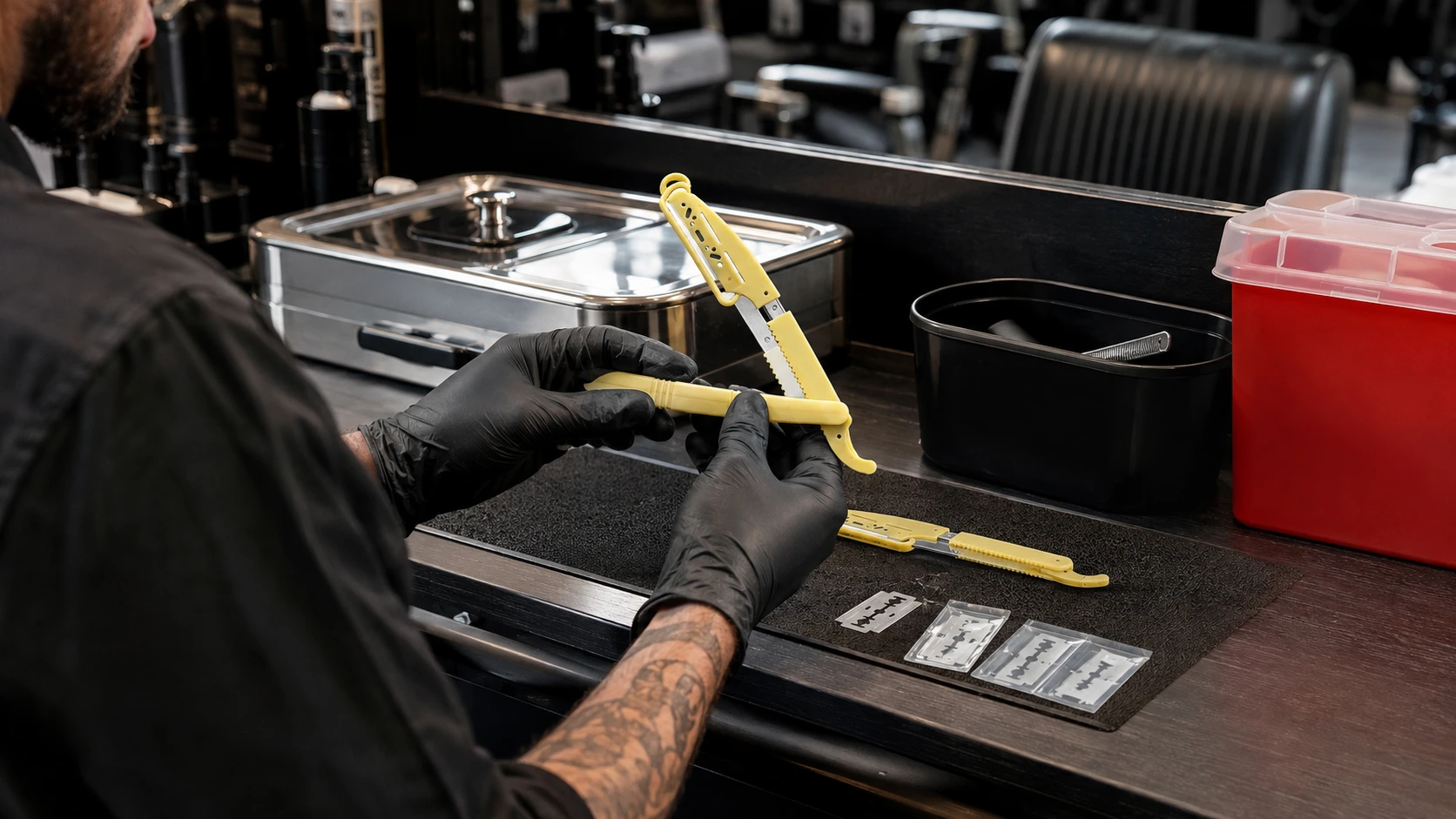
A busy barbershop may complete dozens of neckline, beard-line, and facial-detail services per shift. Every service introduces the conflict: the cutting edge must be fresh for each client, while the tool must return to the clean station without delaying the chair. If the blade is reused, removed unsafely, or loaded into a holder that traps hair and lather, cross-contamination and sharps injuries become risks. If cleaning takes too long, staff may skip steps, queues grow, and service consistency falls. Buying only on unit price makes the problem worse because an awkward blade interface or unsuitable handle adds seconds to every changeover. The solution starts with local hygiene rules, then matches razor topology, grip, cleaning access, disposal, and packaging to turnover.
For high-turnover service, specify one new single-use blade per client, fully accessible reusable surfaces, secure head retention, wet-grip control, and point-of-use sharps disposal. With more than 30 years of razor manufacturing experience, Haward Razor is a specialist OEM and ODM Manufacturer for professional private-label barber systems.
Retailers, importers, wholesalers, and salon distributors should look beyond handle style. The following representative barbershop cases show how D120, D121, and D122 fit different chair volumes, cleaning systems, branding goals, and packaging channels, then convert those operating conditions into a practical sourcing specification.
Start with the Local Hygiene Rule, Not the Handle Design
A professional Razor operates in a wet-zone, skin-contact environment. Lather, hair fragments, skin debris, disinfectant, water, and occasional blood contact can enter gaps around the blade support. Product selection must therefore begin with the intended country, state, or municipality.
Australian public-health guidance for commercial hairdressing states that a new disposable blade should be used for each client, the reusable handle should be cleaned before another blade is fitted, and used blades should enter an appropriate sharps container. California rules separately require disinfectable non-electrical instruments to be cleaned, dried, disinfected according to the disinfectant label, and stored in a clean covered location.
These examples demonstrate the correct sourcing principle: a barber razor Supplier should not promise one universal hygiene workflow. The buyer must confirm local requirements and provide them to the Manufacturer before approving materials, joints, packaging, or instructions.
- Define whether the entire Razor or only the cutting component is single use.
- Identify which reusable surfaces require cleaning, disinfection, drying, and covered storage.
- Confirm the approved disinfectant, concentration, contact time, temperature, and immersion method.
- Place the sharps container close enough to the service area to avoid carrying an exposed blade through the salon.
Choose the System Topology That Matches Service Turnover

The main procurement decision is not simply “straight handle or folding handle.” It is the product’s system topology: which components contact the client, which are discarded, and which must re-enter the cleaning workflow.
| Model and Topology | Confirmed Product Structure | Best-Fit Professional Scenario | Turnover and Cleaning Impact | Key Sourcing Trade-Off |
|---|---|---|---|---|
| D120: full-disposable straight-handle topology | Non-folding, single-blade disposable barber Razor | Walk-in shops, mobile services, events, training or locations with limited cleaning capacity | Fastest reset because the complete unit leaves service after one client | Higher complete-unit consumption and more plastic waste |
| D121: foldable disposable topology | Foldable plastic handle with stainless steel blade; 14.9 × 2.2 cm; 9.8 g; 100 pieces per box | Barber schools, distributor packs, chains wanting familiar folding handling without reusable holders | Folding control with a simple single-use workflow | More material per service than a reusable-handle system |
| D122: replaceable-head topology | Foldable plastic handle, stainless steel cutting component and replaceable barber Razor head | Established salons with documented cleaning stations and trained staff | Only the head is replaced; the handle must complete the approved cleaning cycle | Lower handle consumption but greater process dependence |
A professional barber brand may stock more than one topology. D120 or D121 can support mobile and training channels, while D122 serves salons that already manage reusable tools. An experienced barber razor Supplier should quote these scenarios separately instead of forcing one model across every channel.
Use D120 Where the Entire Workflow Must Be Simple
D120 is suitable when the buyer values a direct open-use-dispose workflow. The barber removes a clean unit from protected stock, completes the detail service, and disposes of the Razor according to local sharps and contaminated-waste requirements. There is no reusable hinge or blade chamber returning to the cleaning station.
This topology can reduce staff decisions during a busy period. It may suit mobile barbers, pop-up grooming events, institutional contractors, training sessions, and stores where several operators share one preparation area. It also provides clear unit accountability: one wrapped Razor can be allocated to one service.
However, the buyer must evaluate waste volume, pack opening speed, storage density, edge protection, and disposal-container compatibility. The lowest unit price can become expensive if bulky packaging consumes station space or if exposed products are damaged before use.
- Test pack opening with dry and gloved hands.
- Confirm that the blade remains protected until the intended opening step.
- Check whether the complete used unit fits the locally specified sharps container.
- Forecast one Razor per service plus an initial 5-10% operating reserve for training, damage, and demand variation.
Use D121 When Barbers Prefer Folding Control but Buyers Want Single-Use Simplicity
D121 combines a familiar folding form with a disposable assembly. Haward’s published specification lists a 14.9 × 2.2 cm size, 9.8 g weight, plastic and stainless-steel construction, and 100 pieces per box. These figures make it easier for a salon distributor to calculate shelf space, case quantities, and consumption.
The folding handle supports several grip positions used during neckline cleanup, sideburn detailing, beard shaping, and outline work. It also shields the cutting area when closed before use or disposal. Because the assembly is not returned as a reusable handle, it avoids the hidden-residue risk associated with a poorly cleaned blade channel.
D121 may be appropriate for barber schools and multi-location chains that want one recognizable handling method without maintaining reusable shavette inventories. A private label shavette program can customize color and packaging, but changes should not obstruct the hinge, blade support, or visual inspection of the product.
Before ordering bulk barber razors, test the hinge across the full production tolerance. It should remain stable during fine detailing without becoming so stiff that the barber applies uncontrolled opening force.
Use D122 When Reusable Handles and Replaceable Heads Fit the Salon System

D122 uses a reusable folding handle + replaceable head topology. The website identifies a plastic handle, stainless steel cutting component, customizable color, and either one-piece bag packaging or Customizable packing. This structure can reduce the number of complete handles consumed, but it transfers more responsibility to the salon’s cleaning process.
A D122 program is best suited to locations with separated dirty, cleaning, drying, and clean-storage zones. After service, the used cutting component must be removed without touching the edge. The handle then follows the locally approved cleaning and disinfection process before it returns to covered storage.
The replaceable blade barber razor should be tested with the exact refill supplied for the project. “Compatible” is not enough. Small dimensional differences may create loose seating, uneven exposure, difficult removal, or partial engagement. The Supplier should control the handle, head, blade-support geometry, and packaging as one approved system.
- Load and remove the head for at least 20 consecutive change cycles on each validation sample.
- Confirm full seating through a visible or tactile engagement feature.
- Inspect for trapped hair, lather, and disinfectant around every interface.
- Verify that no reusable plastic surface becomes sharp, cracked, or loose after repeated processing.
Engineer the Blade-Head Interface for Safe, Fast Replacement

The blade-head interface is the most important functional area in a replaceable blade barber razor. It controls cutting-edge position, exposure consistency, retention, removal, and cleanability. A head that loads quickly but permits partial seating is not a professional solution.
During OEM or ODM development, the Manufacturer should define datums for the head, blade support, cap, and handle. The inspection plan should measure engagement location, left-to-right edge position, retention features, moulding flash, deformation, and head removal behavior. Visual comparison alone cannot control a functional interface.
A useful pilot test uses at least 10 handles from multiple moulding cavities and heads from more than one production lot. Each operator should complete repeated loading, simulated service handling, removal, and disposal. Record incomplete seating, excessive force, accidental edge contact, head movement, and time per change.
The Supplier should also provide change-control protection. Altering resin, mould cavity, cooling parameters, blade support, or refill source can affect fit even when the commercial product name remains unchanged. These variables belong in the approved private label shavette specification.
Validate Grip and Balance with Real Barber Motions
Ergonomics cannot be approved from a product photograph. Barbers rotate the tool between fingers, modify the folding angle, stretch the client’s skin with the opposite hand, and work around ears, jawlines, and the nape. The handle must support precision under dry, damp, lather-contaminated, and gloved-hand conditions.
Build an application trial around the actual service:
- Recruit at least 8-10 trained barbers with different hand sizes and dominant hands.
- Test dry, lightly damp, and gloved grip conditions using non-cutting training samples first.
- Evaluate at least 30 representative motions per user: straight strokes, short detailing strokes, direction changes, and hinge repositioning.
- Record uncontrolled slip, excessive pinch force, pressure points, blocked sight lines, and contact between fingers and the blade area.
- Compare the first five motions with the final five to identify fatigue-related control loss.
Do not add aggressive texture only because it looks “professional.” Deep ribs can retain residue and complicate cleaning. A Customizable grip should balance tactile control with radiused transitions, accessible surfaces, and fast visual inspection.
Build the Cleaning Workflow Before Approving a Reusable Handle

A reusable shavette is only as hygienic as its validated workflow. Cleaning removes visible contamination; disinfection uses an approved chemical process against specified microorganisms. The two terms are not interchangeable. The disinfectant concentration and contact time must follow its label and the destination market’s rules.
For D122 or another private label shavette with a reusable handle, map the process in sequence:
- Remove the single-use head or blade at the service station.
- Dispose of it immediately in the approved sharps container.
- Place the used handle in a clearly marked dirty-tool container.
- Remove visible hair and product residue with the approved detergent method.
- Rinse and dry where required.
- Apply or immerse in the approved disinfectant according to local rules and label directions.
- Dry completely and move the handle into covered clean-tool storage.
Validate material compatibility through at least 50 complete cleaning and disinfection cycles using the intended chemical, concentration, contact time, and temperature. Inspect color change, whitening, cracking, swelling, hinge resistance, label loss, and head fit. A barber razor Supplier should not claim “disinfectant resistant” without naming the chemical conditions tested.
Design Packaging Around Chairs, Stations, and Refill Control
Professional packaging performs a different job from consumer shelf packaging. It must keep new products clean, make first-in-first-out stock control easy, reduce opening time, and prevent loose blades from entering drawers or pockets.
For D120 and D121 bulk barber razors, compare individual protection, inner-box count, dispenser access, carton strength, and waste per service. D121’s published 100-piece box can suit wholesale distribution, but a salon chain may request smaller inner bundles for station replenishment.
For D122, separate reusable handles from replacement heads. The head packaging should protect the cutting edge, support batch traceability, and release one unit without exposing the remaining stock. A private label shavette kit can include handles and starter heads, while refill-only cartons support repeat orders.
Use a simple monthly planning formula:
Required units = Razor-detail services per day × operating days × 1.10 reserve factor
For example, a four-chair shop completing 24 Razor-detail services per day over 26 days should plan approximately 687 single-use cutting units, rounded to the practical case quantity. Calculate handles separately for a replaceable-head system.
Qualify the Manufacturer with Application-Based Testing
Before selecting a barber razor Supplier, request samples from normal production tooling, not only presentation samples. The qualification plan should cover incoming condition, edge protection, head fit, hinge behavior, wet grip, cleaning access, packaging opening, traceability, and carton performance.
| Validation Item | Recommended Pilot Condition | Buyer Decision |
|---|---|---|
| Changeover test | 10 units, multiple operators, 20 loading or disposal cycles where applicable | Can staff change the cutting component without edge contact? |
| Grip trial | 8-10 trained users under dry, damp, and gloved conditions | Does the handle remain controllable during precision work? |
| Chemical compatibility | 50 cycles using the intended disinfectant and label contact time | Does the reusable handle retain fit, surface integrity, and markings? |
| Pack workflow | One simulated working day at each representative station | Can clean stock be accessed without contaminating the remaining units? |
| Traceability review | Finished carton to blade, head, moulding, assembly, and packing records | Can a complaint be isolated to the affected lot? |
For an OEM or ODM order, approve a signed specification covering product drawing, materials, color standard, blade or head configuration, golden sample, performance checks, packaging BOM, labelling, carton marks, inspection plan, and engineering change control. Customizable branding should never override functional or hygiene requirements.
Compare Total Cost per Completed Service
The correct commercial comparison is not handle price alone. Calculate total cost per completed professional service. Include the disposable cutting unit, reusable-handle allocation, cleaning labor, disinfectant, packaging disposal, rejected units, stock loss, sharps handling, and service interruption.
A full-disposable D120 or D121 solution may have a higher material cost but lower cleaning complexity. A D122 replaceable blade barber razor may reduce handle consumption but require more tools in rotation, staff training, validated chemical compatibility, and stronger process control.
For bulk barber razors, model three scenarios: expected volume, peak weekend volume, and supply-delay volume. Maintain sufficient clean handles and unopened cutting units to prevent staff from reusing a product when demand exceeds forecast. The reorder trigger should reflect Supplier lead time, shipping variability, and distributor safety stock.
A professional grooming wholesaler should therefore ask every Manufacturer for a landed, service-level cost model rather than comparing EXW unit prices from different topologies.
References and Professional-Use Boundaries
- California Board of Barbering and Cosmetology – Health and Safety Regulations: cleaning, disinfection, storage, and single-use tool requirements for licensed establishments.
- NSW Health – Hairdressers and Barbers: infection-control, cleanability, storage, handwashing, and equipment guidance.
- Penrith City Council – Hairdressing Guidelines: single-use cutthroat blades, handle cleaning, and sharps disposal guidance.
- OSHA – Bloodborne Pathogens Standard in a Barber Shop: explains that U.S. occupational requirements depend on whether employees have reasonably anticipated occupational exposure.
- Haward Razor – Barber Razor Range: D120, D121, and D122 product classification.
- Haward Razor D121 Product Data: published size, weight, material, package quantity, and customization information.
- Haward Razor D122 Product Data: folding replaceable-head structure, materials, color, and packaging options.
Professional-use rules vary by market. Buyers should confirm licensing, disinfection, labelling, waste, and sharps requirements with the destination authority before approving the product or operating instructions.
Build the Barber Razor Around the Real Service Workflow
Select D120, D121, or D122 by turnover, cleaning capability, grip, disposal, and packaging—not appearance alone. Send Haward Razor your target market, daily service volume, preferred topology, branding, refill plan, and pack format. Our OEM and ODM team will prepare samples and a Customizable sourcing proposal.