A low Razor unit price can disappear inside an inefficient export carton. Oversized retail packs create empty cube, poorly matched cartons waste pallet area, and excessive pallet height exposes bottom layers to compression. The shipment still looks economical on a factory quotation, yet the importer pays more per saleable Razor through container underutilization, dimensional freight, rework, crushed gift sets, bent blister cards, or rejected retail deliveries. The problem worsens when purchasing approves packaging before logistics checks pallet patterns and distribution hazards. Razor carton optimization solves the issue by linking retail-pack dimensions to inner packs, master cartons, pallet footprints, stacking strength, container constraints, and verified product protection before commercial approval and before hidden landed costs appear on the final invoice.
A qualified Supplier must provide measured pack dimensions, carton-board specifications, verified pack-out quantities, pallet-pattern drawings, compression margins, route-specific transit tests, and change control. Haward integrates razor carton optimization into Customizable OEM and ODM programs so freight savings are evaluated together with Razor protection, handling safety, and destination requirements.
Logistics managers, importers, packaging engineers, procurement teams, and engineering wholesalers should continue. The following sections reveal how experienced buyers calculate hidden packaging cube, challenge inefficient carton dimensions, validate pallet loads, and prevent apparent freight savings from becoming product-damage claims after arrival during price negotiations and final shipment approval with Suppliers.
Begin with the Distribution Route and Retail Pack
Design Backward from the Final Handling Environment
A master carton cannot be optimized in isolation. Start with the complete route: factory warehouse, inland trucking, port handling, ocean container, destination warehouse, distribution center, retailer, and possible parcel fulfillment. Each stage creates different compression, vibration, impact, humidity, handling, and labeling risks.
The retail format also changes the engineering problem:
- Disposable Razor packs: high unit count, low individual weight, and strong sensitivity to unused air inside bags or blister packs;
- System-razor refill packs: compact products with sharp dimensional constraints, small components, and high value per cubic metre;
- Razor gift sets: rigid trays, presentation surfaces, handles, refills, and accessories that can move or scuff in transit;
- Retail display packs: hanging cards or display-ready cases requiring flatness, opening strength, and shelf presentation.
The Manufacturer should define what counts as damage before testing. A carton may remain closed while blister cards bend, lubricant strips contact packaging, cartridges leave their cavities, or a premium box loses retail appearance. The buyer’s acceptance criteria must cover both functional product protection and commercially saleable presentation.
Map Every Packaging Level with Measured External Dimensions
Connect Product, Retail Pack, Inner Box, Carton, Pallet, and Container
Packaging drawings often fail because they use nominal dimensions. Board thickness, folding allowance, sealed flaps, blister curvature, bag inflation, dividers, and manufacturing tolerance all change the external cube. Measure conditioned, production-representative samples after packing rather than relying only on CAD.
A controlled packaging specification should record:
- Retail pack: maximum external length, width, thickness, weight, orientation, and barcode face;
- Inner pack: pack count, arrangement, separator, closure method, and measured external size;
- Master carton: internal and external dimensions, board grade, flute, joint, tape, gross weight, and quantity;
- Razor pallet configuration: pallet type, cartons per layer, layers, total height, gross load, overhang, wrap, and corner protection;
- Container plan: pallet count or floor-loaded carton count, door clearance, weight distribution, and restraint method.
Fix the dimension order as L × W × H and the unit as millimetres. Require the Supplier to state whether measurements are internal, external, nominal, or maximum. A 10 mm error repeated across several cartons can destroy an otherwise efficient pallet layout.
Calculate Cube per Saleable Razor Before Comparing Freight
Use Consistent Formulas and Include Expected Damage
Packaging cube optimization should begin with three reproducible calculations:
- Carton volume (m³) = L × W × H / 1,000,000,000, using external dimensions in millimetres;
- Cube per saleable unit = carton volume / accepted saleable units;
- Razor freight cost per saleable unit = total allocated freight / units received without unacceptable damage.
The third formula matters. A tighter carton is not cheaper if compression or abrasion raises the damage rate. The table below is an illustrative pre-validation calculation, not a Haward packing specification or universal industry result.
| Product Format | Original Carton Example | Original Cube per Saleable Unit | Revised Carton Example | Revised Cube per Saleable Unit | Illustrative Cube Reduction |
|---|---|---|---|---|---|
| Disposable Razor | 500 × 400 × 300 mm; 240 razors | 0.250 L per razor | 480 × 380 × 260 mm; 264 razors | 0.180 L per razor | Approximately 28% |
| System-refill cartridge | 450 × 350 × 250 mm; 480 cartridges | 0.082 L per cartridge | 430 × 330 × 220 mm; 504 cartridges | 0.062 L per cartridge | Approximately 24% |
| Razor gift set | 600 × 400 × 350 mm; 24 sets | 3.500 L per set | 580 × 380 × 320 mm; 24 sets | 2.939 L per set | Approximately 16% |
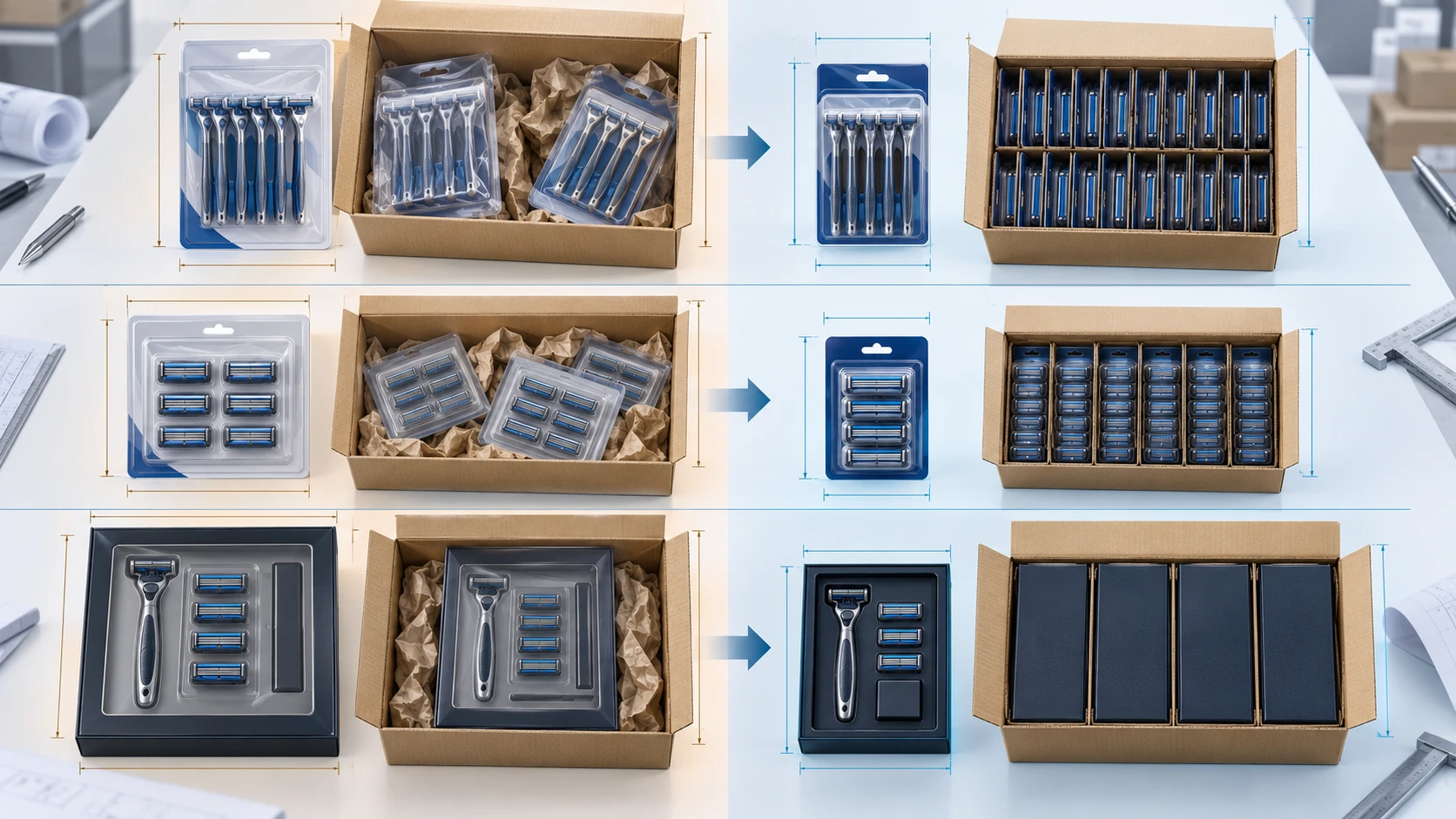
The revised quantity must be physically packed, counted, weighed, conditioned, tested, and approved. Do not calculate freight savings from a theoretical arrangement that operators cannot assemble consistently or that exceeds ergonomic, carrier, retailer, or destination limits.
Design the Master Carton Around the Required Pallet Footprint

Test Rotated Patterns Instead of Accepting the First Rectangular Layout
A small carton reduction does not guarantee a better pallet. The correct objective is total saleable units per pallet or container within weight, height, stability, and compression limits. Packaging software should compare straight, rotated, interlocked, and column patterns. Manual review is still needed because an algorithm may produce a pattern that is difficult to assemble or unstable during forklift handling.
ISO 3394:2012 provides transport-package dimensions based on modular plan sizes and references common pallet series, including 1,200 × 1,000 mm, 1,200 × 800 mm, and 1,219 × 1,016 mm. This supports dimensional coordination, but it does not dictate the best carton for every Razor program.
| Illustrative Pallet Base | Carton Plan Dimension | Cartons per Layer | Layers | Total Cartons | Primary Decision |
|---|---|---|---|---|---|
| 1,200 × 800 mm | 390 × 290 mm | 8 | 5 | 40 | Confirm height, weight, compression, and European handling fit |
| 1,200 × 1,000 mm | 390 × 290 mm | 9 | 5 | 45 | Compare pallet area use with container and warehouse standards |
| 1,219 × 1,016 mm | 390 × 290 mm | 9 | 5 | 45 | Verify North American retailer and pallet-exchange requirements |
These pattern counts are simplified planning examples and must be confirmed in palletization software and a physical trial. Report both pallet-area utilization and volume utilization; a full footprint can still waste cube when the permitted load height is not used.
Control Compression Before Removing Board or Adding Layers
Calculate the Bottom-Carton Load and Verify the Complete Pack
The bottom carton does not experience laboratory-perfect loading. Humidity reduces corrugated performance. Pallet deck gaps, carton misalignment, overhang, vibration, long dwell time, and load eccentricity increase stress. Gift sets may carry concentrated loads through rigid trays, while loosely filled disposable packs may allow side panels to bow.
A packaging engineer should define:
- Board construction: liner and medium specification, flute, basis weight, moisture control, and recycled-content condition;
- Material strength: edge crush, burst, puncture, or other properties selected for the box design;
- Box compression requirement: measured on the complete filled carton under defined conditioning;
- Stacking safety factor: buyer-defined for storage time, humidity, pallet pattern, and transport route;
- Allowable deformation: limits for carton bulge, height loss, pack damage, and load instability.
ISO 12048:1994 describes compression and stacking tests using compression equipment, while ISO 2234:2000 addresses static-load stacking tests. Neither assigns a universal pass force to Razor cartons. Acceptance depends on actual gross weight, layers, storage duration, climate, carton geometry, and the buyer’s damage definition.
Match Transit Testing to the Real Distribution Channel

Do Not Use One Drop Test for Every Shipment
A master carton shipped on a stable full pallet faces different hazards from one moving through parcel networks. Testing should reproduce the intended route closely enough to compare designs and verify protection.
- ISTA 3E is relevant to unitized loads of similar packaged products moving through full-truckload distribution.
- ISTA 3B addresses packaged products moving through less-than-truckload systems.
- ISTA 3F applies to packages shipped from distribution centers to retail outlets as part of mixed loads.
- ISTA 3A addresses individual packaged products of 70 kg or less moving through parcel delivery systems.
The buyer must select the current protocol, package category, conditioning, orientation, test sequence, sample count, and damage criteria. ISTA guidance also recommends retesting when the product, package, or process changes. An OEM packaging approval should therefore identify the exact test version and laboratory, not merely state “ISTA tested.” Keep pre-test photographs, raw data, post-test inspection records, and tested samples as part of the packaging validation dossier.
Balance Cube Efficiency with Weight and Human Handling
A Denser Carton Is Not Automatically a Better Carton
Razors are usually cube-sensitive, but some dense refill or metal-handle assortments can reach handling limits before the carton is spatially full. More units per box may reduce carton count while increasing manual-handling risk, conveyor problems, bottom-panel stress, or retailer rejection.
For each proposed master carton, record:
- Net and gross weight, including moisture-sensitive packaging variation;
- carton centre of gravity and lift orientation;
- destination retailer or warehouse weight and dimension limits;
- carrier dimensional-weight rules for air or parcel freight;
- pallet gross load, forklift capacity, rack limit, and container payload;
- required hand holes, reinforcement, labels, or mechanical handling.
Compare both actual weight and chargeable weight. Air and parcel services may bill a light but bulky Razor carton by dimensional weight. Ocean containers often become cube-constrained first, but dense mixed loads can become payload-constrained. The quotation should state which transport assumption supports the claimed razor freight cost reduction.
Prevent Overhang, Underhang, Movement, and Mixed-Load Damage
Engineer the Unit Load as One Packaging System
Pallet overhang leaves carton edges unsupported and vulnerable to impact. Excessive underhang wastes pallet area and can allow neighbouring loads or stretch film to distort the stack. Interlocked patterns improve lateral stability but may reduce vertical compression strength compared with aligned columns. The correct choice depends on carton strength, pallet deck, transport vibration, and restraint.
A controlled razor pallet configuration should specify:
- carton orientation and layer diagram;
- maximum overhang and underhang tolerance;
- anti-slip sheets, corner boards, top cap, straps, and stretch-film specification;
- film pre-stretch, wrap pattern, containment force, and tail control;
- pallet label position and barcode visibility;
- maximum pallet height, gross mass, and double-stacking rule.
The IMO/ILO/UNECE CTU Code provides guidance for safe packing and securing of cargo transport units. The loading team should also distribute mass appropriately, fill or restrain voids, protect goods from container surfaces, and document the approved loading plan. Container fill percentage alone does not prove a safe export load.
Verify the Pallet, Certificates, and Export-Marking Scope
Audit Compliance at Material, Packaging, and Shipment Release
ISO 6780:2003 specifies principal dimensions and tolerances for flat pallets, while ISO 8611-1:2025 and ISO 8611-2:2025 cover pallet test methods and performance requirements. Pallet certification does not replace a trial with the actual Razor load and support conditions.
For raw-wood pallets and dunnage in international trade, verify applicable ISPM 15 treatment and marking requirements. Processed wood products may be treated differently, so destination rules and material construction must be confirmed.
Key control points include:
- Packaging-design audit: drawings, tolerances, materials, claims, and approved samples;
- Supplier audit: corrugated-board source, test capability, traceability, and change control;
- Pilot-pack audit: pack-out quantity, weight, sealing, pallet pattern, and compression test;
- Pre-shipment audit: carton condition, marks, quantities, pallet restraint, and container loading;
- Arrival review: damage mapping, photos, claim codes, and corrective action.
An ISO 9001 certificate may support quality-system control. Where required, verify the current scope and status of BRCGS Packaging Materials, FSC Chain of Custody, or recycled-content documentation rather than applying certificate logos without evidence.
Make Packaging Optimization Part of the Razor RFQ
Compare Quotations on Landed Cost and Verified Protection
A Razor RFQ should request more than unit price and master-carton quantity. Require the Manufacturer to submit a packaging hierarchy drawing, measured dimensions, material specification, gross weights, pallet pattern, loading assumptions, test plan, and optimization alternatives.
Ask every Supplier to quote:
- units per retail pack, inner box, master carton, pallet, and container;
- carton and pallet external dimensions with tolerances;
- estimated cubic metres and gross mass per 1,000 saleable Razors;
- one baseline and one packaging cube optimization option;
- tooling, test, artwork, carton-plate, pallet, and protective-material costs;
- damage criteria, validation protocol, samples, and change-approval responsibility.
Calculate landed razor freight cost using the same route, Incoterm, container type, carrier basis, pallet policy, duty basis, and damage allowance. A cheaper carton is not a commercial saving when it increases labour, retailer chargebacks, claim administration, product loss, or brand damage. Freeze the approved pack-out in the BOM and require written approval before any dimension, board, divider, tape, pallet, or stacking change.
Reduce Freight Without Transferring Cost into Product Damage
Choose a Supplier that can connect retail-pack design, master-carton strength, pallet utilization, transit testing, and landed-cost evidence. Send Haward your Razor format, pack dimensions, destination, shipping route, pallet standard, and damage criteria for a Customizable OEM or ODM packaging optimization review.