

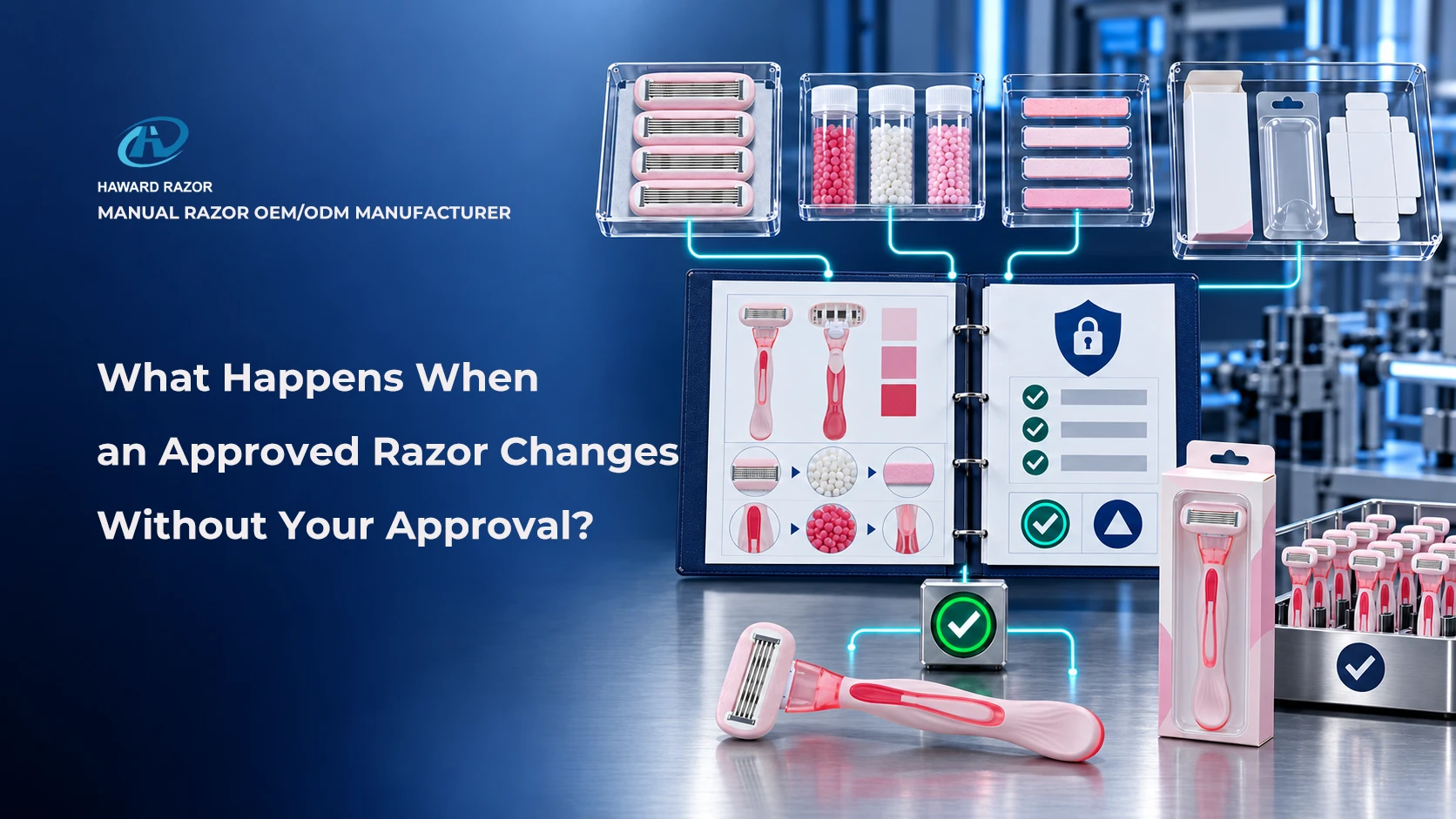
A Razor can pass qualification, enter mass production, and then become a different product. A sub-supplier changes blade steel, a resin grade is replaced, a lubricating-strip formula is reformulated, or a packaging converter changes board thickness. The shipment may look acceptable, yet cutting consistency, color, assembly fit, shelf life, labeling, or compliance evidence may no longer match the approved specification. The buyer discovers the change after complaints, inspection failures, or retailer rejection, when finished inventory is already in transit. A Supplier audit does not prevent this post-approval risk. The solution is a contractual razor supplier change notification process requiring advance notice, documented impact assessment, agreed revalidation, written approval, effective-lot traceability, and controlled inventory transition before any proposed change reaches production.
A qualified Supplier must identify every material, process, source, site, tooling, formula, artwork, and packaging change; notify the buyer before implementation; submit risk and validation evidence; and wait for written approval. Haward uses this disciplined OEM PCN approach to protect Customizable Razor specifications across repeat orders.
Compliance managers, technical buyers, procurement teams, and engineering wholesalers should continue. The following sections reveal the contract controls experienced buyers use to stop unapproved substitutions, distinguish temporary deviations from permanent changes, allocate revalidation duties, and maintain traceability without turning every minor adjustment into a commercial delay.
Separate Change Notification from the Supplier Audit
An Audit Reviews the System; a PCN Controls the Approved Product
A Supplier audit checks whether the Manufacturer has suitable procedures, trained personnel, equipment, records, and quality controls. It is an important qualification activity, but it is only a snapshot. A factory can pass an audit and later change a blade source, resin supplier, color masterbatch, strip formula, mold cavity, assembly method, or packaging converter.
An OEM PCN clause governs what happens after the Razor has been approved. It should apply throughout tooling, pilot production, mass production, repeat orders, and any agreed service period. The clause must also cover changes initiated by sub-tier suppliers, not only changes made inside the final assembly factory.
- Supplier audit: evaluates capability and management controls.
- Engineering change: proposes a permanent alteration to the approved product or process.
- Temporary deviation: requests limited permission to depart from a requirement.
- Emergency notification: reports an event that may affect safety, compliance, quality, or supply continuity.
Keeping these mechanisms separate avoids a dangerous assumption: approval of the Supplier is not approval of every future material or process decision.
Define Which Razor Changes Require Advance Notice
Control Form, Fit, Function, Compliance, Appearance, and Supply Risk
The contract should not rely on phrases such as “major change” or “material change” without definitions. The buyer and Manufacturer may interpret those phrases differently. Instead, attach a practical change matrix to the supply agreement, quality agreement, or approved specification.
| Razor Component | Changes Requiring Notification | Main Buyer Risk | Typical Evidence |
|---|---|---|---|
| Blade system | Steel grade or source, thickness, heat treatment, coating, edge process, blade geometry, weld or staking method, sharpening line, production site | Performance drift, corrosion, retention failure, inconsistent assembly | Material certificate, dimensional report, cutting-force comparison, corrosion and retention results |
| Plastic and elastomer parts | Resin grade, Manufacturer, color masterbatch, additive, recycled content, regrind level, TPR grade, molding site, mold or cavity repair | Fit failure, color mismatch, cracking, odor, reduced grip or compliance change | Technical data sheet, declaration, color data, dimensional study, assembly and aging tests |
| Lubricating strip | Polymer matrix, active or botanical ingredient, pigment, fragrance, dimensions, extrusion process, formula supplier, adhesion method | Shelf-life change, swelling, detachment, color or sensory difference | Formula declaration, compatibility test, wet-use comparison, adhesion and aging data |
| Retail and transport packaging | Board or film grade, thickness, recycled content, ink, adhesive, coating, dieline, barcode, artwork, pack count, converter, pallet pattern | Retail rejection, damage, unreadable codes, incorrect claims or freight instability | Artwork proof, barcode verification, packaging declaration, compression and transit results |

The list should also cover tooling relocation, automation changes, inspection-method changes, outsourcing, site transfers, and discontinuation. If the Supplier is uncertain whether notification is required, the contract should require disclosure rather than silent implementation.
Set Notice Windows by Risk and Urgency
Do Not Use One Deadline for Every Change
A single notice period is easy to write but difficult to operate. New blade steel may require extensive testing, while a corrected master-carton typo may need only an artwork review. A practical razor supplier change notification clause uses risk-based categories and states that the countdown begins only when the buyer receives a complete evidence package.
| Change Class | Illustrative Notice Window | Examples | Implementation Rule |
|---|---|---|---|
| Major permanent change | 90 days before planned implementation | Blade source, resin grade, strip formula, production site, major tooling or packaging structure | No production or shipment before written approval |
| Minor controlled change | 30 days before planned implementation | Nonfunctional artwork correction, inspection equipment replacement with equivalent capability | Buyer determines whether samples or testing are required |
| Emergency event | Immediate notice, normally within one business day of confirmation | Material discontinuation, compliance concern, site interruption, suspected mixed lots | Quarantine affected stock and obtain disposition before use or shipment |
These periods are buyer-defined examples, not universal industry rules. Final timing should reflect test duration, launch schedule, destination compliance, inventory exposure, and the Razor program’s commercial risk.
Require a Complete Change-Notification Package

Make the Supplier Explain What Changes and What Does Not
A short email stating that a material is “equivalent” is not a usable PCN. The Supplier should submit one controlled document that allows technical, quality, compliance, procurement, and planning teams to reach the same decision.
A complete OEM PCN clause should require:
- PCN number, submission date, responsible contacts, and affected Razor SKU list;
- Current specification and proposed specification shown side by side;
- Reason for the change, including shortage, discontinuation, improvement, cost, capacity, or compliance;
- Affected material, sub-supplier, equipment, tooling, cavity, process, site, artwork, or test method;
- Risk assessment covering form, fit, function, appearance, user experience, compliance, packaging, and delivery;
- Proposed validation plan, sample quantity, test methods, acceptance criteria, and supporting certificates;
- Current inventory, work in progress, purchase commitments, and proposed cutover date;
- First affected batch, production date, purchase order, shipment, and traceability method; and
- Fallback or recovery plan if the change fails validation.
The buyer should reject an incomplete submission without starting the approval clock. This prevents urgent approval pressure caused by missing evidence.
Match Revalidation to the Actual Razor Risk
Do Not Repeat Every Test, but Do Not Test Only the Changed Part
Razor material change control should use a documented impact assessment to select revalidation. A blade steel change may affect cutting force, corrosion behavior, edge durability, cartridge geometry, and weld strength. A resin change may affect shrinkage, pivot movement, cartridge release, color, odor, and drop resistance. A lubricating-strip change may affect swelling, adhesion, water response, color stability, and shelf-life behavior. Packaging changes may affect barcode readability, product retention, compression, transit damage, claims, and destination documentation.
A practical review sequence is:
- Compare the approved and proposed material or process specification.
- Identify direct effects on the changed component.
- Identify interface effects on the assembled Razor and packaging system.
- Review destination-market declarations and customer-specific requirements.
- Define samples across relevant lots, cavities, lines, or sub-supplier batches.
- Approve the test plan before the Supplier begins qualification.
- Review raw data, failed samples, certificates, and the conclusion.
Sampling may use a buyer-approved plan informed by ISO 2859-1:2026 for attribute inspection, but routine AQL inspection does not replace design or process revalidation.
Make Written Approval the Only Authorization to Implement

Silence, Sample Receipt, or a Purchase Order Must Not Mean Consent
The contract should identify who can approve a change. A sales representative, freight coordinator, or factory planner should not be able to authorize a technical substitution through an informal message. Written approval should come from the buyer’s named quality, engineering, compliance, or authorized procurement role.
The supplier deviation approval workflow should be clear:
- The Manufacturer submits a complete PCN and proposed validation plan.
- The buyer classifies the change and confirms required evidence.
- The Supplier produces marked samples without mixing them into normal stock.
- Both parties review results, compliance documents, commercial impact, and cutover risk.
- The buyer approves, rejects, or requests additional work in writing.
- Approved drawings, bills of materials, artwork, control plans, and golden samples are revised.
- The first changed shipment is clearly identified and receives enhanced inspection.
The clause should state that no response is not approval. Receipt of samples, forecasts, or purchase orders also does not waive the notification requirement.
Control Temporary Deviations and Emergency Substitutions
Limit Permission by Quantity, Time, Lot, and Purchase Order
A temporary deviation is not a shortcut around razor material change control. It is limited permission for a defined situation. The request should identify the nonconforming or alternative condition, affected quantity, production lot, purchase order, risk assessment, inspection method, labeling, and expiry date.
Approval should expire automatically when any stated limit is reached. It should not revise the drawing, create precedent, or authorize future orders. The Supplier must maintain segregation between approved-standard stock and deviation stock.
For an emergency shortage, the Manufacturer should first disclose:
- Available compliant inventory and days of supply;
- Confirmed orders and production already exposed;
- Alternative material or source and its differences;
- Minimum validation possible before use;
- Additional inspection or containment controls; and
- A return-to-standard or permanent-change plan.
Schedule pressure does not transfer the technical decision to the Supplier. The buyer must still approve the defined risk.
Control Sub-Tier Suppliers and Inventory Cutover
Extend the Clause Beyond the Final Razor Assembly Factory
Many meaningful changes begin below the direct Supplier. A steel mill may discontinue a grade, a compounder may reformulate resin, a lubricating-strip producer may replace an ingredient, or a packaging converter may change ink or adhesive. The direct Manufacturer should remain responsible for obtaining notice from these sub-tier sources and evaluating the effect on the approved Razor.
The PCN should also state how old and new inventory will be handled:
- Last-time buy: quantity and deadline for discontinued approved material;
- Lot segregation: physical and electronic separation of current and changed stock;
- Cutover rule: first production batch and first affected shipment;
- No mixed shipment: unless the buyer expressly accepts mixed versions;
- Traceability: link material lots to finished Razor batches, cartons, and purchase orders; and
- Obsolete stock: written disposition for unused labels, cartons, strips, resin, or components.
This prevents a technically approved change from becoming an uncontrolled warehouse transition.
Connect Compliance Documents to Every Approved Change
Update Declarations, Artwork, and Technical Files Before Shipment
A material or packaging change can invalidate evidence even when the finished Razor looks identical. The review should identify which declarations, safety data, restricted-substance reports, recycled-content records, artwork approvals, and destination files require revision. The applicable list depends on the market and product classification.
ISO 9001:2026 emphasizes planned and controlled operations, documented information, evaluation, and improvement within a quality management system. It supports disciplined change control, but an ISO 9001 certificate does not replace a product-specific PCN clause. For EU packaging, Regulation (EU) 2025/40 makes packaging composition, recyclability, labeling, and technical documentation increasingly important. Buyers should verify applicability with qualified compliance advisers.
The approval record should list each document reviewed, its revision, issue date, issuing party, affected SKU, and validity. Shipment must not begin while required evidence still describes the old resin, strip, ink, packaging structure, or production site.
Write Commercial Consequences into the Contract
A Notification Clause Needs a Practical Remedy
A razor supplier change notification clause is weak if it explains the process but says nothing about unauthorized implementation. The agreement should define reasonable remedies subject to governing law and negotiation.
- Buyer right to quarantine, inspect, reject, or require replacement of affected goods;
- Supplier responsibility for agreed retesting, sorting, rework, recall support, or disposal costs caused by an unauthorized change;
- Immediate disclosure of affected lots, shipments, destinations, and remaining inventory;
- Root-cause analysis and corrective-action deadline;
- Enhanced inspection or probation status after a serious breach;
- Right to audit change-control records and sub-tier notification evidence; and
- Escalation, suspension, or termination rights for repeated or high-risk violations.
The clause should also protect Supplier confidentiality by limiting access to information needed for evaluation. Cost changes should be negotiated separately from technical approval. Approving a safer or more compliant change does not automatically accept a price increase, and agreeing to a price does not approve the engineering change.
Protect the Approved Razor Throughout Repeat Production
Choose a Manufacturer that treats approval as the start of controlled production, not permission to substitute silently. Send Haward your Razor specification, destination markets, risk priorities, and required notice periods. We can develop a Customizable OEM or ODM change-notification matrix, revalidation plan, and written approval workflow for your program.