A summer grooming campaign, holiday gift set, or retailer promotion may depend on a fixed shelf date. The buyer approves artwork late, demand rises above forecast, and the Supplier discovers that injection molding is available but cartridge assembly and packing are full. Finished handles accumulate while Razors cannot ship. Marketing spend is committed, retailers expect inventory, and air freight becomes the only rescue. The crisis is not insufficient factory output. It is a failure to reserve processes, define a frozen production zone, and separate forecast demand from firm purchase commitment. A structured razor capacity reservation converts the launch calendar into approved machine hours, assembly slots, packaging windows, material commitments, escalation triggers, and a documented recovery path before capacity becomes scarce.
A qualified seasonal Razor Supplier must prove process-level capacity, define forecast and frozen zones, reserve molding, cartridge assembly and packaging separately, control material exposure, and maintain a tested launch recovery plan. Haward applies these controls to Customizable OEM and ODM programs instead of offering an undefined promise of factory availability.
Category managers, retailers, supply chain directors, procurement teams, and engineering wholesalers should continue. The following sections reveal the planning details experienced buyers use to secure peak-season output, detect bottlenecks early, control forecast changes, and recover a launch without automatically creating excess inventory or uncontrolled premium freight.
Plan Backward from the Commercial Launch Date
Separate the Shelf Date from the Factory Completion Date
A seasonal razor production plan should begin with the date inventory must be available to the retailer, not the date the factory should start. The buyer must work backward through distribution-center receipt, customs clearance, international transport, origin handling, export inspection, finished-goods release, packing, assembly, molding, component purchasing, artwork approval, and sample approval.
The critical date differs by campaign:
- Summer peak: inventory may need to arrive before warm-weather travel and body-grooming demand accelerates.
- Gifting peak: premium packs, inserts, stands, brushes, refill cartridges, and display cartons add assembly and packing steps.
- Promotion peak: retailer media, merchandising, and price events may make the required shelf week commercially immovable.
Build one calendar with a target date and a latest acceptable date for every gate. Add a buyer-defined contingency allowance for customs, vessel changes, inspection holds, and rework. The Manufacturer should confirm which dates are assumptions and which are contractual milestones. This prevents a marketing launch date from being mistaken for a complete production schedule.
Map Capacity by Process Instead of Accepting One Factory Number
Build a Capacity Cube for Each Razor Family
A factory may have enough annual output yet lack the specific resource needed for one seasonal SKU. Injection molding capacity is measured in machine hours and mold cycles. Cartridge assembly depends on platform, blade count, feeding systems, inspection, and changeover. Packaging depends on blister sealing, pouching, cartoning, labeling, kitting, and line clearance. These capacities are related, but they are not interchangeable.
| Illustrative Resource | Planning Unit | Available Peak Capacity | Proposed Reservation | Remaining Headroom | Main Bottleneck Risk |
|---|---|---|---|---|---|
| Injection molding | Machine-hours per month | 1,600 | 1,200 | 25% | Mold availability, resin, color change and maintenance |
| Cartridge assembly | Approved cartridges per week | 200,000 | 150,000 | 25% | Blade platform, component feeding and inspection speed |
| Retail packaging | Finished packs per week | 120,000 | 100,000 | 16.7% | Artwork, printed material, sealing cycle and pack complexity |

The figures above are buyer-defined examples, not Haward output claims or universal standards. A reliable Manufacturer should calculate demonstrated rate, planned working time, changeover loss, maintenance, expected yield, current bookings, and approved overtime. The lowest feasible stage determines the launch volume. Reserving 150,000 cartridges is commercially useless if only 100,000 compliant retail packs can be completed.
Define Forecast Windows and Frozen Zones Before Booking Capacity
Give Each Horizon a Different Commitment Level
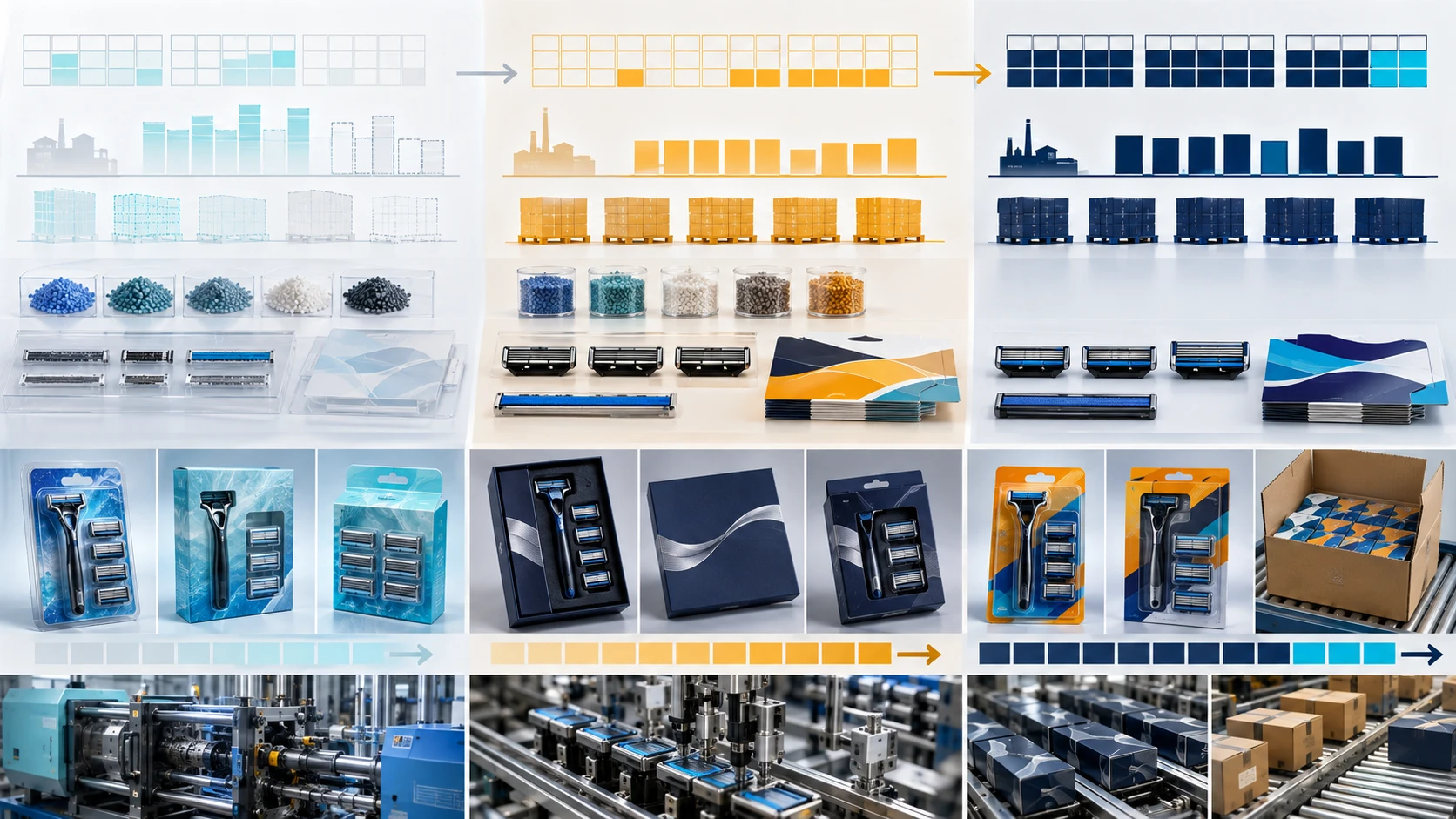
A rolling forecast is useful for labor, material, and capacity planning, but it should not automatically authorize full production. Official manufacturing systems use time fences because schedule changes become harder as cumulative lead time is consumed. Oracle planning guidance describes demand, planning, and release time fences, while SAP purchasing guidance distinguishes firm, material or trade-off, and planning zones.
An OEM or ODM agreement may translate that logic into:
- Planning window: an indicative 16- to 26-week view used to assess demand, labor, tooling and long-lead exposure.
- Material authorization window: written authority to purchase named custom resin, blades, lubricating components or printed packaging within a value cap.
- Frozen production zone: accepted SKU quantities and production sequence that cannot change without senior approval and cost review.
- Shipment window: confirmed dispatch dates, carton quantities, documents and destination instructions.
These horizons are illustrative. They must follow actual component and manufacturing lead times. The contract should state who may change each zone, what evidence is required, and which cost follows cancellation.
Convert Factory Capacity Booking into a Commercial Agreement
Pay for a Defined Resource and Service Level
Factory capacity booking should specify more than an annual Razor quantity. The reservation must identify the factory site, product family, mold or platform, process, period, base quantity, upside band, minimum firm order, and acceptance deadline. If a reservation fee or deposit applies, the agreement should say whether it is refundable, credited against purchases, or retained when the buyer fails to release volume.
Key commercial terms include:
- Reserved base: capacity held for accepted releases during defined weeks.
- Upside option: additional output subject to written Supplier confirmation.
- Release deadline: last date the buyer can convert reserved capacity into a firm order.
- Unused-capacity rule: whether the Manufacturer may reallocate an unconfirmed slot.
- Cancellation ladder: different liability for forecast, committed material, work in progress, and finished goods.
- Evidence package: production plan, capacity calculation, current bookings, inventory report, and confirmation record.
A qualified razor capacity reservation Supplier should reject impossible upside rather than accept it and fail later. Commercial clarity protects both sides from unfunded capacity, unused-slot disputes, and unauthorized inventory.
Control Product Mix Before It Consumes the Reserved Slot
Reserve Platforms First, Then Manage Colors and Packs
Seasonal plans often fail because the total quantity remains stable while the mix changes. A retailer may reduce one handle color, add a gift pack, increase refill count, or shift units from bulk to blister packaging. The Supplier still sees the same total Razor volume, but molding cavities, decoration, components, carton materials, and packaging minutes change.
The capacity agreement should classify changes:
- Platform-neutral change: a color or assortment change that uses approved materials and stays inside established batch rules.
- Resource-shifting change: a pack or configuration change that moves demand from one line to another.
- Engineering change: a new material, mold, decoration, cartridge, component, or drawing revision requiring validation.
- Launch-scope change: an additional SKU or market requiring new artwork, labels, languages, testing or compliance records.
Set mix-freeze dates before the final production freeze. Shared cartridge platforms and Customizable handles can improve flexibility, but only after compatibility, quality, and packaging assumptions are approved. The Manufacturer should recalculate bottleneck capacity whenever pack architecture changes; a stable annual unit count does not prove the original reservation remains valid.
Treat Packaging as a Production Resource, Not a Final Administrative Step
Protect Artwork, Materials, and Line Time
Packaging is frequently the last visible activity and one of the earliest launch risks. Gift sets may require trays, inserts, brushes, stands, refill compartments, security labels, multilingual instructions, and display cartons. Promotion packs may depend on a retailer-specific barcode, price flash, or shelf-ready configuration. A late file approval can block material purchasing even when molded and assembled Razors are ready.
The seasonal razor production plan should include:
- Artwork freeze: final date for approved content, dieline, colors, barcode and language.
- Packaging proof approval: signed control sample before bulk printing.
- Printed-material authorization: approved quantity and liability for buyer-specific components.
- Pack-line qualification: sealing, fit, appearance, label and carton checks on the approved configuration.
- Packaging capacity slot: scheduled line, shift, output rate and changeover allowance.
- Contingency format: a pre-approved simplified pack only where brand, compliance and retailer rules permit it.
Do not assume bulk-packed Razors can be converted into a retail launch at any time. Finished pack capacity, not assembled product quantity, determines retail readiness.
Audit Readiness Before the Frozen Zone Begins
Use Launch Gates That Test Evidence, Not Optimism
A factory presentation cannot confirm seasonal readiness. Before the schedule freezes, the buyer should review evidence at defined audit nodes. The depth depends on product risk, customization, market, and previous Supplier performance.
- Capacity audit: verify routing, demonstrated rate, planned shifts, mold count, maintenance status, staffing, current bookings and bottleneck calculation.
- Material readiness review: confirm blade, resin, lubricating component, decoration, printed pack and alternate-source status.
- First-article approval: approve Customizable components, colors, logos, cartridge connection and packaging samples.
- Pilot production gate: record yield, cycle time, inspection findings, line balance and packaging output.
- Pre-production review: freeze drawings, bill of materials, golden samples, artwork, test plan and purchase release.
- Pre-shipment release: verify quantity, inspection, traceability, labels, cartons and export documents.
ISO 9001 requires processes to be planned, implemented, controlled, monitored and evaluated. Certification supports confidence in the quality-management system, but it does not prove that a particular seasonal slot is available. Capacity evidence and product-specific controls remain necessary.
Build a Launch Recovery Plan Before the First Delay

Use Triggered Options with Owners and Decision Deadlines
A launch recovery plan should not begin with “use air freight.” Transport cannot recover a mold delay, failed validation, missing cartridge component, or unavailable packaging line. Recovery begins by identifying the constraint and protecting the retail-critical quantity.
| Illustrative Trigger | Immediate Containment | Recovery Options | Approval Owner |
|---|---|---|---|
| Material arrival slips by 5 working days | Recalculate critical path and protect available components | Approved alternate lot, resequencing, partial production | Buyer engineering and Supplier quality |
| Pilot yield falls below the agreed gate | Stop scale-up and contain affected output | Corrective action, tooling adjustment, additional pilot | Quality and manufacturing leaders |
| Packaging slot becomes the constraint | Prioritize launch-critical SKU and preserve approved packs | Extra shift, second validated line, staged packing | Brand packaging and factory operations |
| Confirmed ship date threatens shelf availability | Separate minimum launch quantity from replenishment | Split shipment, partial air bridge, later ocean balance | Supply chain director and finance |
All triggers and time periods are examples. Each option requires cost, quality, compliance, and schedule review. The plan must name decision owners, response deadlines, evidence, premium-cost approval, and the point at which the launch scope changes.
Measure Reservation Performance Through the Entire Peak
Use KPIs That Expose Capacity Drift Early
During summer, gifting, or promotion production, weekly governance is often more useful than a monthly status meeting. The buyer and Supplier need one version of demand, capacity, inventory, quality, and logistics.
- Forecast-to-firm conversion: quantity moved from planning into accepted orders on time.
- Reserved-capacity utilization: confirmed production divided by reserved process capacity.
- Schedule adherence: output completed against the frozen weekly plan.
- Bottleneck headroom: unused qualified capacity at molding, cartridge assembly, and packaging.
- First-pass yield: conforming output before rework at each critical process.
- Inventory by stage: raw materials, work in progress, assembled Razors, packed goods, and blocked stock.
- Recovery burn-down: overdue units, remaining gap, responsible owner, and expected closure date.
Review results by SKU and process, not only total units. A green factory total can conceal a red gift-pack line. Escalation rules should identify when sales, procurement, engineering, quality, operations, logistics, and finance must join the decision. This turns factory capacity booking into measurable launch-risk control.
Close the Seasonal Program and Improve the Next Reservation
Reconcile Commitments, Costs, and Remaining Inventory
After the peak, compare forecast, firm orders, production, shipments, receipts, sell-in timing, and remaining stock. Review unused capacity, premium freight, overtime, line changes, scrap, rework, excess custom material, and obsolete packaging. Determine whether each cost resulted from buyer change, Supplier performance, approved recovery, or an undefined contract boundary.
The closeout should answer:
- Which process became the real constraint?
- Was the frozen zone long enough for actual cumulative lead time?
- Which forecast changes caused material or packaging exposure?
- Did the reserved headroom protect the launch or remain unnecessarily idle?
- Which recovery action saved time, and what premium did it create?
- What inventory can be reused in the next season?
- Which contract, approval, or audit gate needs revision?
The next razor capacity reservation should use demonstrated data rather than copying the previous agreement. Update process rates, changeover assumptions, commitment windows, mix rules, packaging capacity, escalation thresholds, and recovery options.
Reserve the Capacity Your Launch Actually Needs
Choose a Supplier that proves process-level capacity and separates forecasts from firm commitments. Send Haward your launch date, Razor platforms, SKU mix, packaging formats, forecast windows, and destination markets to develop a Customizable OEM or ODM seasonal capacity plan and documented recovery path.